

What if that nagging stiffness you feel every morning isn’t just a side effect of getting older, but a loud SOS from your nervous system? It’s incredibly common to dismiss a dull ache or a recurring headache as just another part of a busy life, but these are often the primary signs you need a spinal alignment. You might even notice you look slightly tilted in mirrors or feel like your body is constantly fighting against itself just to stand up straight. It’s frustrating when pills won’t touch the pain and you’re left feeling out of sync with your own frame.
We know how exhausting it is to live with physical uncertainty, and you deserve to understand exactly what your body is trying to tell you. This article will help you identify the physical red flags and subtle symptoms that indicate your spine is out of balance so you can finally find lasting relief. We’ll walk through seven specific indicators that it’s time for professional care and explain how a gentle, personalized adjustment works to restore your comfort. By the end, you’ll have the clear criteria needed to take the next step toward feeling like yourself again.
Key Takeaways
- Understand how a misaligned spine acts like a pinched garden hose, restricting the vital flow of communication between your brain and the rest of your body.
- Learn to recognize the physical signs you need a spinal alignment, from persistent neck stiffness to surprising “hidden” indicators like uneven wear on your shoe soles.
- Discover three simple home self-assessments, including the Mirror Test, to check your posture and range of motion for early warning signs.
- Find out why chronic fatigue and mental fog are often symptoms of nervous system stress caused by a spine that is out of balance.
- Get a clear picture of what to expect during a professional diagnostic exam and how tailored adjustments provide a structured path toward lasting relief.
What is a Spinal Alignment and Why Does It Matter?
Imagine your spine as a perfectly balanced stack of twenty-four movable bones. When these vertebrae are stacked exactly as they should be, your body moves with ease and your nervous system operates without interference. This state is what we call proper spinal alignment. It’s the foundation of your physical health, yet it’s easy to take for granted until things start to feel “off.” Learning to recognize the early signs you need a spinal alignment can prevent minor discomfort from turning into chronic pain.
Your spine isn’t just a support beam; it’s a protective casing for your central nervous system. Think of your nerves like a garden hose. When the spine is aligned, “water” or vital communication signals flow freely from your brain to every cell in your body. If a vertebra shifts even slightly, it’s like stepping on that hose. This kink in the system disrupts the flow, leading to the “red flags” that often signal trouble. To understand the mechanics behind correcting these kinks, it helps to ask: What is a spinal adjustment? Essentially, it is a controlled, specific force applied to a joint to restore its natural movement and position.
Many people mistake the sound of a “crack” for the primary goal of treatment. In reality, that sound is simply a release of gas bubbles from the joint fluid. A professional adjustment is far more than just making a noise; it is a precise manual correction tailored to your unique anatomy. Unlike a generic stretch or a self-crack at home, a chiropractor uses specific diagnostic data to move the exact bone that’s causing the interference. This precision is what allows the body to begin its natural healing process.
The Concept of Subluxation
When a vertebra loses its proper position or fails to move correctly, we call it a subluxation. These shifts don’t always happen during a major event like a car accident or a fall, which we categorize as macro-traumas. Often, they stem from micro-traumas: the repetitive stress of sitting at a desk for eight hours, looking down at a phone, or sleeping in an awkward position. Over time, these small stresses add up. They cause the spine to drift out of place and create the subtle signs you need a spinal alignment that many people ignore until the pain becomes undeniable. For those seeking professional insight into these structural shifts, Golden Bay Chiropractic Works offers a detailed look at how chiropractic care restores balance and function.
Keeping your spine in check does more than just stop the immediate ache. It sets the stage for long-term wellness chiropractic care by reducing systemic inflammation and keeping your joints lubricated. When your vertebrae are stacked correctly, your range of motion increases and your body doesn’t have to work as hard to perform simple tasks. This efficiency leads to better sleep, more energy, and a significantly lower risk of wear-and-tear injuries as you age. It’s about maintaining your body’s structural integrity for years to come.
The Most Common Signs You Need a Spinal Alignment
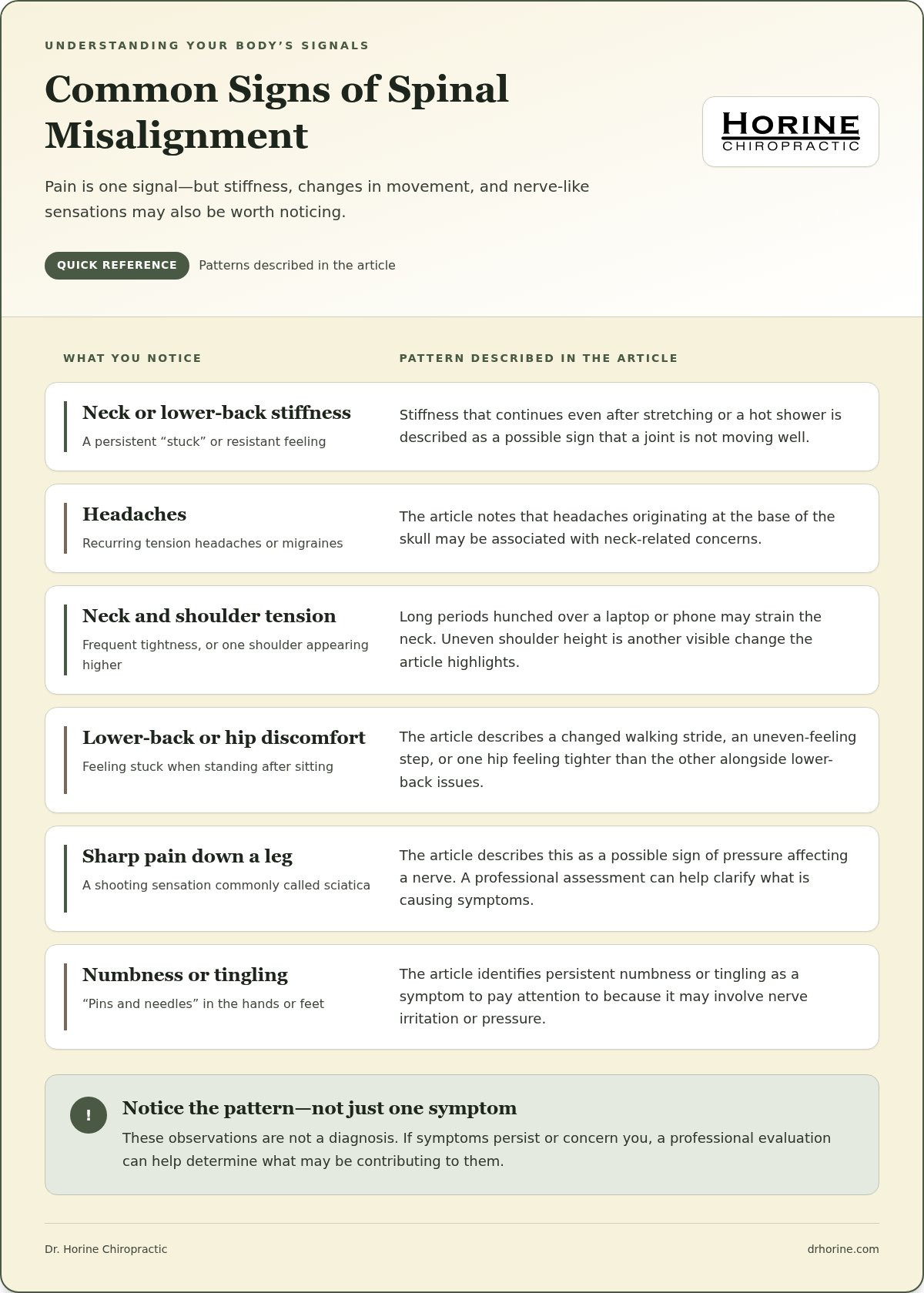
While pain is the most obvious signal, it’s rarely the first one. Your body often whispers before it screams. Identifying the early signs you need a spinal alignment can be the difference between a quick correction and months of recovery. When your vertebrae are out of position, the symptoms often manifest as persistent stiffness in the neck or lower back that simply won’t go away, even after a long session of stretching or a hot shower. This physical resistance is your body’s way of guarding a joint that isn’t moving correctly.
Neurological symptoms are equally telling and should never be ignored. Research into the effectiveness of spinal manipulation shows significant evidence for its role in managing tension headaches and migraines that originate at the base of the skull. If you experience sharp, shooting pains down your legs, commonly known as sciatica, your nerves are likely under direct pressure from a misaligned disc or vertebra. Similarly, persistent numbness or a “pins and needles” feeling in your hands and feet suggests that the communication lines between your brain and limbs are being pinched.
Persistent Neck and Shoulder Tension
Many of us spend hours each day hunched over laptops or smartphones. This “tech neck” creates a massive amount of strain on the cervical spine, flattening the natural curve that supports your head. If you find yourself constantly rubbing your traps or notice that one shoulder sits higher than the other in photos, you’re seeing physical evidence of a structural shift. Addressing this neck pain early helps restore that natural curve before it leads to permanent joint wear or chronic muscle fatigue.
Lower Back Pain and Hip Issues
Lower back issues often present as a feeling of being “stuck” when you try to stand up after sitting in a car or a desk chair. This occurs when a pelvic tilt or a misaligned lumbar vertebra alters your walking gait, forcing your hips to compensate for the imbalance. If your stride feels uneven or one hip feels tighter than the other, it’s a clear indicator of a structural issue. You can explore more about lower back pain relief Visalia to see how these imbalances are diagnosed. If these symptoms sound familiar, scheduling a diagnostic assessment can provide the clarity you need to move forward.
The ‘Hidden’ Signs of Spinal Misalignment
Beyond the obvious aches, your body often provides visual and internal clues that your framework is out of balance. These indicators aren’t always painful, which makes them easy to overlook during a busy week. Identifying the subtle signs you need a spinal alignment requires looking at how your body functions as a whole, not just where it hurts. For instance, you might notice your joints “pop” or “crack” more frequently during normal movements, like reaching for a high shelf or turning to look behind you. This is often a sign that a joint is trying to find its proper home within an imbalanced system.
Chronic fatigue or a lingering sense of “brain fog” can also be one of the most frustrating indicators of structural stress. When your spine is misaligned, your nervous system is essentially running a background program of constant stress, which drains your energy reserves. This can even manifest as digestive sluggishness or a weakened immune system. Because your nerves control the function of your organs, a structural shift in the mid-back can interfere with the signals your stomach and intestines need to work efficiently. We believe in being upfront about every aspect of care, including understanding the potential risks of spinal manipulation, to ensure you feel fully informed before starting any treatment plan.
The Shoe Sole Test
One of the easiest ways to check your alignment is to inspect your favorite pair of shoes. Grab a pair of sneakers you’ve worn for several months and look closely at the heels. In a balanced body, the wear should be relatively even across both shoes. If you notice that one heel is worn down significantly more than the other, or if the outside edges are disappearing faster than the rest of the sole, your hips are likely out of level. This “hidden” sign indicates a functional leg-length discrepancy, where your body is forced to compensate for a tilted pelvis with every step you take.
Neurological ‘Echoes’
Misalignment often creates “neurological echoes,” which are sensations that aren’t quite pain but certainly don’t feel right. You might experience a “pins and needles” sensation in your fingers or toes that comes and goes without warning. These signals suggest that a nerve is being intermittently compressed, even if the pressure isn’t constant enough to cause a sharp ache. This can also disrupt your sleep quality, as your body struggles to find a neutral position where the nerves aren’t being irritated. For those dealing with these radiating signals, specialized sciatica treatment in Visalia focuses on calming these nerve paths by restoring proper vertebral spacing. Addressing these echoes early can prevent them from developing into the more severe signs you need a spinal alignment later on.
Self-Assessment: 3 Simple Ways to Check Your Alignment at Home
You don’t need a medical degree to notice when your body is out of sync. While a professional diagnostic exam is the only way to get a definitive answer, performing a few simple checks can help you identify the signs you need a spinal alignment before they escalate into debilitating pain. These tests are designed to help you listen to what your body is saying and give you a clear baseline for your structural health.
The Mirror Posture Check
To perform this test, stand in front of a full-length mirror. Close your eyes and march in place for a few seconds to let your body settle into its most natural, comfortable position. When you open your eyes, look closely at your reflection without trying to “fix” your posture. Check for these three indicators:
- The Head Tilt: Does one ear sit higher than the other, or is your head slightly turned to one side?
- Shoulder Level: Is one shoulder hiked up toward your ear while the other hangs lower?
- Hand Position: Do your hands hang evenly at your sides, or does one hand seem to rest further forward on your thigh?
A “forward head” position, where your ears are in front of your shoulders rather than directly above them, is a common sign of cervical strain. If you notice these imbalances, your spine is likely compensating for a shift in your vertebrae.
Measuring Your Range of Motion
Restricted movement is often one of the first signs you need a spinal alignment, even if you aren’t feeling sharp pain yet. To test this, sit tall in a chair and slowly rotate your head to the left as far as it will comfortably go, then repeat to the right. You should be able to turn your chin almost to your shoulder on both sides. If one side feels “stiff” or if you experience a sharp pinch or a “catching” sensation, it indicates a subluxation in the neck. You can also try tilting your head toward each shoulder. If the range of motion is uneven, your cervical spine isn’t moving as a cohesive unit.
The Weight Distribution Test
If you have two identical bathroom scales at home, you can perform a surprisingly accurate check of your pelvic alignment. Place the scales side-by-side and stand with one foot on each. Look down at the readings. In a perfectly aligned body, the weight should be distributed evenly between both legs. If one scale shows five or more pounds than the other, your hips are likely tilted. This imbalance forces one side of your body to work harder with every step you take, which eventually leads to the “hidden” wear patterns we discussed earlier.
These at-home tests provide a practical way to verify the physical signals your body is sending. If your self-assessment reveals a clear imbalance or restricted movement, scheduling a personalized diagnostic exam is the most effective way to confirm your findings and start a structured recovery plan.
What to Expect During Your Professional Alignment in Visalia
Once you have identified the physical signs you need a spinal alignment through your own observations, the next step is to replace uncertainty with professional clarity. At Dr. Horine Chiropractic, we believe that the most effective treatment begins with a thorough diagnostic assessment. We have served the Visalia community since 1987, and we’ve learned that every patient’s structural history is unique. Your consultation isn’t a rushed formality; it’s a methodical investigation into how your body is functioning and where your nervous system communication is being hindered.
We prioritize an honest, no-pressure approach that focuses on your specific needs rather than high-pressure sales tactics. During your exam, we map out your specific areas of tension and misalignment. This allows us to create a precise manual adjustment that is tailored to your unique “pain map.” We don’t believe in one-size-fits-all treatments. Instead, we use a customized approach to move the exact vertebrae that are causing your symptoms, ensuring that each adjustment is both gentle and effective. This personalized attention is why so many neighbors have trusted us with their care for over three decades.
Your First Visit at Dr. Horine Chiropractic
Your initial visit is designed to be unhurried and attentive. We start with a detailed history and a physical exam to find the root cause of your discomfort, whether it is neck pain, lower back stiffness, or sciatica. Our Visalia office is built on a warm, neighborly atmosphere where you can feel at ease. You won’t find the cold, clinical environment of a traditional hospital here. We’re focused on treating people, not just symptoms, and we take the time to explain exactly what we find before we begin any care. This transparency helps lower your guard and ensures you feel like a partner in your own recovery.
The Path to Lasting Relief
The journey toward feeling like yourself again often involves a combination of clinical care and practical lifestyle adjustments. For many local workers in Visalia, this includes specific posture advice to counter the effects of long hours at a desk or in the field. We help you understand how to maintain your alignment between visits so that your body remains resilient and balanced. While some patients feel quick relief after their first few adjustments, we also focus on long-term wellness to prevent future issues from taking root. If you are ready to address the signs you need a spinal alignment, you can schedule your diagnostic exam with Dr. Horine today.
Take the Next Step Toward Lasting Comfort
Your body is designed to move without constant resistance or nagging stiffness. Whether you’ve noticed uneven wear on your shoe soles or felt a persistent “kink” in your neck after a long day at the office, these signals are more than just minor annoyances. They are the clear signs you need a spinal alignment to restore your body’s internal communication. Ignoring these red flags often leads to more complex nerve pain or chronic joint fatigue that becomes much harder to resolve later on.
You don’t have to navigate this journey alone. Since 1987, our team has provided honest, patient-centered care to the Visalia community, focusing on targeted relief for neck, back, and nerve pain. We invite you to Book Your Initial Consultation at Dr. Horine Chiropractic to receive a thorough, no-pressure diagnostic exam. It’s time to stop guessing about your health and start following a clear, structured path toward feeling like yourself again. We look forward to being your partner in health and helping you rediscover the comfort and mobility you deserve.
Frequently Asked Questions
Is a spinal alignment painful?
Most patients find the adjustment process remarkably comfortable and often report an immediate sense of relief. You might feel a brief moment of pressure as the joint is moved, but it’s rarely described as painful. Some people experience mild muscle soreness for about 24 hours following their first session, similar to how you feel after a new workout. Our Visalia clinic prioritizes gentle, precise movements to ensure you feel at ease throughout the entire process.
How many sessions does it take to realign the spine?
The number of sessions depends entirely on the severity of your condition and how long the issue has been present. While some patients experience significant improvement within just one to three visits, chronic misalignments usually require a structured plan over several weeks to achieve lasting stability. Dr. Horine has served the Visalia community since 1987 and uses a detailed diagnostic exam to outline an honest, personalized timeline for your specific recovery goals.
Can a spinal misalignment cause headaches?
Yes, frequent tension headaches are one of the most common signs you need a spinal alignment. When the vertebrae at the base of your skull shift out of place, they irritate the surrounding nerves and cause muscles to tighten. This structural stress often radiates upward, resulting in persistent pain that medication doesn’t fully resolve. Correcting the alignment in your neck can reduce this pressure and provide long-term relief from recurring migraines. If you’re experiencing these symptoms, consulting a primary care facility like Hatmed Medical Centre can help ensure your health concerns are evaluated comprehensively.
That sound is simply the release of gas bubbles from the fluid surrounding your joints. When an adjustment is performed, the joint space opens slightly, allowing oxygen, nitrogen, and carbon dioxide to escape. It’s a natural physiological process called cavitation and isn’t the sound of bones “cracking” or rubbing together. Understanding this often helps lower a patient’s hesitation, as the sound is a harmless byproduct of restoring proper joint motion.
How do I know if my child needs a spinal alignment?
Children often show physical cues like uneven shoulders, a tilted head, or one hip that appears higher than the other. You might also notice they favor one side while playing or complain of persistent “growing pains” in their legs. Since children are highly active, their spines are susceptible to micro-traumas from sports or heavy school backpacks. A gentle assessment in our Visalia office can ensure their structural development stays on the right track.
Will my insurance cover a chiropractic alignment in Visalia?
Many major insurance providers in the Visalia area do offer coverage for chiropractic care, though the specifics vary by plan. We recommend contacting your insurance company directly to verify your benefits for diagnostic exams and adjustments. Our team focuses on transparency and integrity, so we’ll help you understand your coverage options upfront. This ensures there are no surprises, allowing you to focus entirely on your physical improvement and comfort.
What happens if I leave my spine out of alignment?
Leaving a misalignment unaddressed allows the body to develop permanent compensation patterns that lead to premature joint wear and chronic inflammation. Over time, the “kink” in your nervous system communication can cause the surrounding muscles to weaken or become permanently tight. This structural decay often results in more severe signs you need a spinal alignment, such as radiating nerve pain or a significant loss of mobility that interferes with your daily life.

Article by
Dr. Russell Horine, DC Chiropractor
Horine Chiropractic has established a strong reputation for delivering exceptional results in treating complex back and neck pain cases. Their primary objective is to serve patients efficiently and compassionately, aiding them in their journey to wellness. Horine Chiropractic uses a comprehensive, groundbreaking approach to treating stubborn back and neck pain. They have been helping Visalia’s backs, necks, and everything in between for a combined 45 years. They create a comprehensive approach to help their patients meet their health needs. Horine Chiropractic customizes treatment plans to meet each patient's unique health needs. The clinic is accepting new patients and providing compassionate care to those in need.
Medical Disclaimer
This content is provided for general educational and informational purposes only and is not intended as medical advice, diagnosis, or treatment. Individual conditions and treatment needs vary. Please consult a qualified healthcare professional regarding your specific symptoms and treatment options.