
What if the sharp ache in your spine actually has nothing to do with your back at all? It’s incredibly frustrating to spend weeks on stretches or treatments for your lower back only to have the pain come roaring back the moment you stand up. You might feel like you’re stuck in a cycle of temporary fixes, wondering if you’ll ever find a real answer or if surgery is your only path forward. If you’ve ever asked yourself can hip problems cause lower back pain, you aren’t alone, as these two areas of your body function as a single, interconnected unit.
We believe you deserve more than just a quick fix; you deserve a partner who listens to your whole story. This guide will help you uncover the hidden link between your hips and your spine, giving you the clarity you need to identify the true source of your discomfort for lasting relief. We’ll explore how to tell the difference between these two issues, look at non-surgical ways to restore your mobility, and discuss why a thorough diagnostic approach is the essential first step toward getting back to the life you love.
Key Takeaways
- Understand the “Rigid Hip” theory and how restricted movement in your joints can force your lower back to overcompensate.
- Discover the specific diagnostic clues that answer the question: can hip problems cause lower back pain?
- Identify the timing and location of your symptoms to help you distinguish between a hip issue and a spinal problem.
- Learn a gentle four-step self-assessment to evaluate your own mobility and pinpoint where your body is truly struggling.
- Explore how a whole-person diagnostic approach can provide a clear path to relief and improved mobility without the need for surgery.
The Hip-Spine Connection: Can Hip Problems Cause Lower Back Pain?
It’s common to treat the lower back as an isolated island, but your body doesn’t work that way. When you’re struggling with persistent discomfort, one of the first questions we often investigate is: can hip problems cause lower back pain? Often, the hip is a silent contributor, hiding behind symptoms that feel like they belong solely to the spine. Healthcare providers call this overlap Hip-Spine Syndrome, which is a condition where dysfunction in both areas contributes to a single, frustrating pain experience.
When a hip joint loses its ability to rotate freely, the mechanical stress travels upward, forcing the lower back to twist and bend beyond its healthy limits. This creates a kinetic chain reaction that puts immense pressure on your lumbar discs and muscles. Your brain often experiences referred pain, where it misinterprets signals from the deep hip joint as coming from the lower back. While there are many common causes of lower back pain, treating the spine alone won’t provide lasting relief if the hip is the true driver of the problem.
Why the Anatomy of the Hip and Spine Overlap
Your hips and spine are neighbors with a very thin wall between them. They share complex nerve pathways in the lower lumbar region, meaning a pinched nerve or inflammation in the hip can send pain signals straight to your back. The psoas muscle is a major player here; it’s the only muscle that connects your spine directly to your hip bone. If this muscle is tight or injured, it pulls on your lumbar vertebrae every time you move your leg. Additionally, the Sacroiliac (SI) joint acts as the physical bridge between the two, making it easy for stress to transfer between your pelvis and your spine.
Common Hip Conditions That Mask as Back Pain
Several specific hip issues are notorious for masquerading as spinal problems. Hip osteoarthritis often causes a stiff, limited range of motion, which forces you to arch your back more just to stand up straight. This leads to compensatory back strain that feels like a primary injury. Labral tears, which involve the cartilage in the hip socket, can subtly change your walking gait and put uneven pressure on your lower discs. We also frequently see hip impingement (FAI) in younger, active adults in Visalia. This condition limits how far the hip can move, causing the lower back to overwork during simple daily activities like sitting or climbing stairs.
How Hip Dysfunction Forces Your Lower Back to Overwork
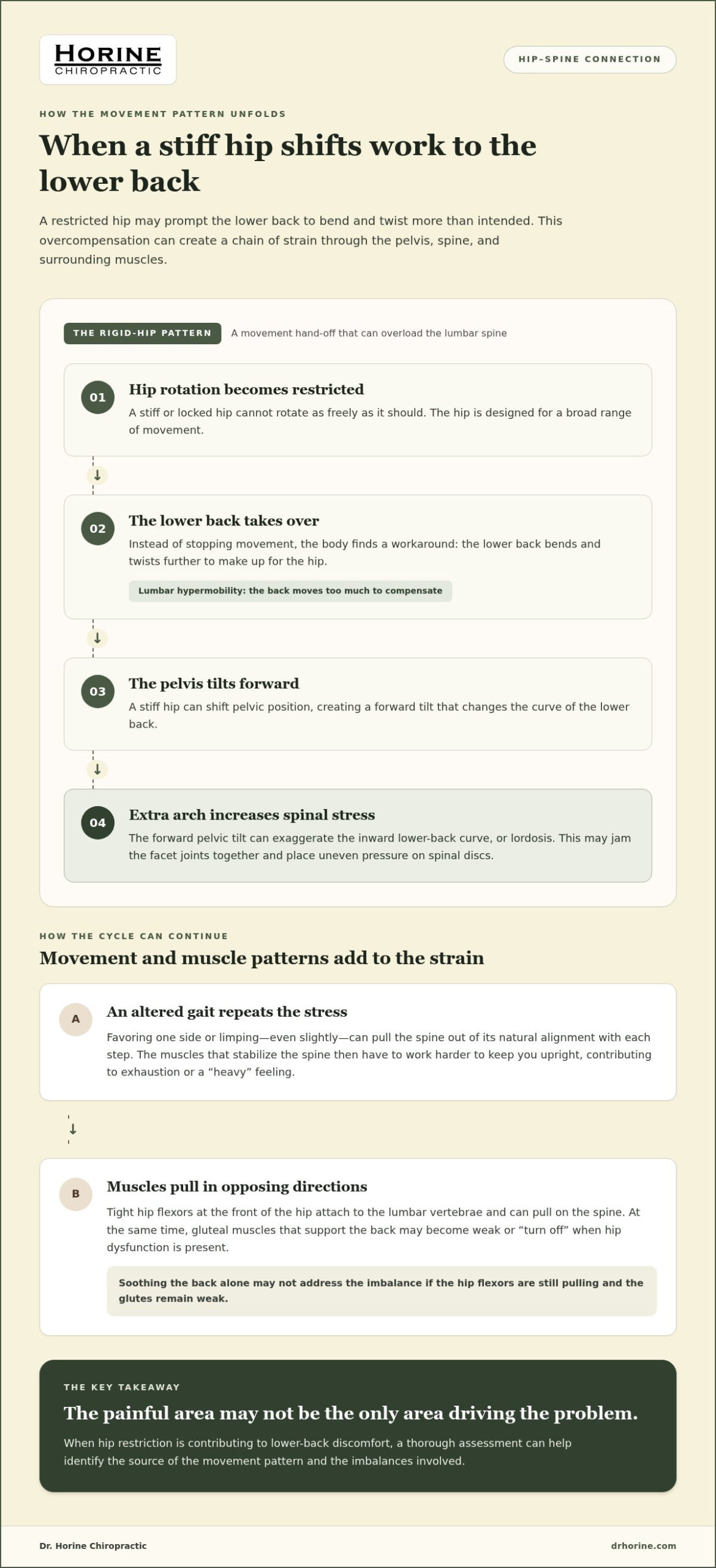
The mechanics of your body rely on a delicate hand-off of movement between joints. When we look at how can hip problems cause lower back pain, we often point to the “Rigid Hip” theory. Your hip is a ball-and-socket joint designed for a massive range of motion. If that joint becomes stiff or locked, your body doesn’t just stop moving; it finds a workaround. Usually, that workaround is your lower back. Because the hip isn’t rotating as it should, your spine is forced to bend and twist further than it was ever intended to. This creates a state of lumbar hypermobility, where your back moves too much to make up for a hip that moves too little. In many cases, your lower back is simply the innocent victim of your hip’s laziness.
This mechanical failure often shows up in how you walk. If you’re favoring one side or limping, even slightly, your spine is pulled out of its natural alignment with every step. Over thousands of steps a day, this micro-trauma adds up. According to research on hip and lumbar spine movement, there is a direct correlation between these restricted hip patterns and chronic spinal discomfort. When your gait is altered, the muscles that stabilize your spine have to work twice as hard to keep you upright, leading to the exhaustion and “heavy” feeling many patients describe.
The Overcompensation Loop
When your hip joint is stiff, it often forces your pelvis to tilt forward. This shift isn’t just a change in posture; it creates a domino effect. As the pelvis tilts, it increases the inward curve of your lower back, known as lordosis. This exaggerated arch jams the facet joints of your spine together and puts uneven pressure on your spinal discs. You might feel like your back is tight, but that tightness is actually a defensive response to the mechanical stress caused by your hips. If you’re tired of chasing symptoms, a thorough diagnostic assessment can help determine if your pelvis is stuck in this loop.
Muscular Imbalances and “Tug-of-War”
This physical struggle isn’t just about bones and joints; it’s a muscular tug-of-war. Tight hip flexors, which sit at the front of your hip, are physically attached to your lumbar vertebrae. When they shorten, they literally pull on your spine. Meanwhile, the gluteal muscles, which should be supporting your back, often “turn off” or become weak when hip dysfunction is present. You might spend hours stretching your back to find relief, but if the hip flexors are still pulling and the glutes are still weak, the pain will return. True recovery requires addressing these imbalances rather than just soothing the area that hurts.
How to Tell if Your Pain is Coming from Your Hip or Your Spine
If you’re struggling to find the source of your discomfort, creating a mental “pain map” is the best place to start. While you might wonder can hip problems cause lower back pain, the actual location of the sensation often tells the real story. True hip joint pain usually feels sharp or stabbing and stays relatively localized to the joint area. In contrast, spinal issues often create a radiating or burning sensation that feels like it’s traveling. Understanding these differences is the first step toward finding shooting pain in leg relief, as it helps determine whether we need to focus on a joint or a nerve.
Timing also offers a significant clue. Pay attention to when your symptoms flare up. If you’re stiff in the morning but feel better after moving around, your spine or general inflammation might be the culprit. If your pain gets progressively worse with every step you take during a walk, the hip joint is a likely suspect. These patterns help us distinguish between a structural issue in the joint and a functional issue in the spine.
The “Groin Test” for Hip Issues
One of the most reliable indicators of a hip problem is where you feel it. True hip joint pain almost always manifests in the groin or the front of the thigh. You might notice a sharp catch when getting in and out of a car or a deep ache when you bend over to put on your socks. Many patients use what we call the “C-Sign” to describe their hip pain. They place their hand over the side of their hip, with the thumb in the back and the forefinger in the groin, forming a “C” shape. If this matches your experience, your hip is likely the primary driver of your symptoms.
The “Buttock and Leg Test” for Spinal Issues
When the spine is the source, the pain map usually shifts backward. Discomfort that centers in the buttocks or travels down the back of the leg is a classic sign of a spinal issue. If that sensation travels past your knee, it’s almost certainly leg pain from back issues rather than a hip joint problem. Numbness, tingling, or a “pins and needles” feeling are hallmarks of nerve compression in the spine, and seeking pinched nerve treatment in Visalia can help address these symptoms without resorting to surgery. You might also notice that a simple cough or sneeze sends a jolt of pain through your back; these sudden increases in internal pressure rarely affect the hip joint, but they can easily irritate a sensitive spinal disc.
4 Steps to Assess Your Hip-Back Connection at Home
While imaging like MRIs or X-rays can be helpful, they don’t always capture the full picture of how your body moves in real time. These at-home assessments are designed to provide clues about your mobility rather than a final medical diagnosis. As you go through these steps, it’s vital to move slowly and listen closely to your body’s feedback. If you feel any sharp or electric pain at any point, stop the movement immediately. Recording your observations will help you provide clear, actionable information to your Visalia chiropractor during your initial consultation.
Step 1: The Seated Hip Rotation Check
Sit on a firm chair with your feet flat on the floor. Try to cross your right ankle over your left knee, allowing your right knee to fall outward toward the floor. Observe the height of that knee; does it stay high and tight, or does it drop down comfortably? Pay attention to any “pinching” sensations in the groin area. Repeat this on the left side and compare the two for symmetry. If one side is significantly more restricted, it’s a primary indicator that can hip problems cause lower back pain by forcing the spine to twist to make up for the lack of joint rotation.
Step 2: The Single-Leg Stance Balance Test
Stand near a wall or a sturdy piece of furniture for safety and lift one leg off the ground. While balancing on the standing leg, notice if your opposite hip “drops” toward the floor or if your lower back begins to ache immediately. This test is excellent for revealing gluteal weakness and what experts call a Trendelenburg gait. When the hip stabilizers are weak, the pelvis becomes unstable, which forces the muscles in your lower back to work overtime just to keep you upright and balanced.
Step 3: The Thomas Stretch (Hip Flexor Tension)
Lie on your back at the very edge of your bed so your legs can hang off the side. Pull your right knee toward your chest and hold it firmly with both hands. Watch what your left leg does; it should stay flat against the mattress. If your left leg lifts off the bed, it’s a sign that your hip flexors are incredibly tight. Since these muscles are physically anchored to your lumbar vertebrae, that “lifting leg” shows you exactly how your hips are constantly pulling on your lower back every time you take a step.
Take a moment to write down your findings from these three steps. Note which side felt more restricted and whether any of these movements felt like they “triggered” your usual back pain. If you’re tired of guessing where your pain starts, you can schedule a diagnostic exam to get a professional assessment of your hip-spine health.
Finding Lasting Relief: The Chiropractic Approach to Hip-Spine Health
Finding an answer to the question can hip problems cause lower back pain is only half the battle; the other half is implementing a structured plan that actually works. At Dr. Horine Chiropractic, we’ve served the Visalia community since 1987 by focusing on the root cause of pain rather than just chasing symptoms. Dr. Horine starts every patient relationship with a comprehensive physical examination of the whole person. We don’t just look at where it hurts; we look at how your body moves as a complete unit. By assessing the mechanical relationship between your pelvis and your lumbar spine, we can determine exactly where the overcompensation loop began.
Manual adjustments play a vital role in restoring motion to joints that have become locked or restricted over time. When your hip joint isn’t moving correctly, it creates a cascade of tension that often leads to pinched nerves in the lower back. Our approach to chiropractic for nerve compression addresses the spinal side of this equation while simultaneously using mobilization techniques to free up the hip. The goal is simple: provide quick relief to lower your pain levels immediately, then develop a clear path toward long-term mobility and strength.
Personalized Treatment Plans in Visalia
Honest, patient-centered care is the foundation of everything we do. During your first-visit diagnostic assessment, you can expect a thorough conversation where we listen to your entire history of discomfort. We combine traditional spinal adjustments with targeted hip mobilization to create a personalized treatment plan that fits your specific lifestyle. Whether your pain comes from a recent injury or decades of wear and tear, we’re here to provide the clarity you’ve been missing without the need for invasive procedures.
Beyond the Adjustment: Posture and Mobility
Recovery doesn’t end when you leave our office. We provide customized stretches designed to maintain your hip flexibility at home, ensuring those joints stay loose and functional. For our many Visalia desk workers, we offer ergonomic tips to prevent the hip-back strain that comes from prolonged sitting. These simple adjustments to your daily routine help prevent the overcompensation patterns from returning, keeping you active and comfortable for the long haul. If you’re still wondering can hip problems cause lower back pain in your specific case, the best way to find out is through a hands-on evaluation. It’s time to stop learning to live with the ache and start moving with confidence again.
Take the Next Step Toward Lasting Mobility
You’ve spent long enough wondering if your back pain is just a spinal issue or if something deeper is at play. Understanding that your hips and spine work as a single functional unit is the first step toward finding real relief. Whether it’s a “rigid hip” forcing your spine to overwork or a specific joint issue masquerading as a back strain, you now have the clarity to look for the true source. We’ve explored how can hip problems cause lower back pain by disrupting your natural alignment and forcing your muscles into a constant tug-of-war.
Dr. Horine has been serving Visalia families with honest care since 1987, specializing in these complex Hip-Spine diagnostic challenges. We don’t believe in one-size-fits-all solutions; instead, we provide personalized, non-surgical treatment plans tailored to your unique story. You deserve a partner who listens and a plan that focuses on your long-term health. Schedule your comprehensive diagnostic exam with Dr. Horine today to get the clear answers you’ve been missing. We’re ready to help you move with confidence and comfort once again.
Frequently Asked Questions
Can a hip labral tear cause lower back pain?
Yes, a labral tear often leads to compensatory movements that affect your spine. When the cartilage in your hip socket is damaged, you’ll likely tilt your pelvis or change your stride to avoid sharp pain. This shift creates uneven pressure on your lumbar discs and facet joints. While the tear itself is in the hip, the resulting muscle tension and spinal misalignment are what cause the back to ache over time.
How do I know if my leg pain is sciatica or a hip problem?
Sciatica typically produces a burning or electric sensation that travels past the knee and into the foot. Hip joint issues usually center in the groin or the front of the thigh and rarely cross the knee. If sitting down makes the pain worse, it’s often a spinal nerve issue. If walking or rotating your leg triggers a sharp catch in your groin, the hip joint is the more likely culprit.
Is it possible to have both hip arthritis and a herniated disc at the same time?
It is very common for patients to have both conditions simultaneously, which is a situation known as Hip-Spine Syndrome. Wear and tear in the hip joint can change how you walk, which then accelerates the degeneration of your spinal discs. We often see patients who have been treated for one issue while the other was completely overlooked. A thorough diagnostic exam is necessary to determine which condition is currently driving your symptoms.
Why does my back hurt more when I walk long distances but my hip feels stiff?
This pattern occurs because your lower back is doing the work your stiff hips can’t handle. As you walk, your hips should rotate freely to absorb impact. If they’re stiff, that force travels directly into your lumbar spine with every step. After a long distance, your back muscles become exhausted from overcompensating for the lack of hip mobility. This is a classic example of how can hip problems cause lower back pain during exercise.
Can a chiropractor in Visalia help with hip pain if I don’t want surgery?
Yes, chiropractic care offers a non-surgical path to improving joint function and reducing inflammation. Dr. Horine uses manual adjustments and mobilization techniques to restore a healthy range of motion to “locked” hip joints. By improving the way the ball-and-socket joint rotates, we can take the mechanical stress off your lower back. This conservative approach focuses on long-term mobility and avoids the risks and long recovery times associated with invasive surgical procedures.
What are the best stretches for lower back pain caused by tight hips?
The figure-four stretch and the half-kneeling hip flexor stretch are two of the most effective movements for this issue. The figure-four stretch helps open the deep gluteal muscles that often tighten when the hip joint is struggling. The kneeling hip flexor stretch targets the psoas muscle, which connects your leg directly to your spine. Performing these movements daily can help release the tension that pulls your lower back out of its natural alignment.
How long does it take to see relief from hip-related back pain with chiropractic care?
Many patients experience a noticeable decrease in sharp pain within the first few visits as joint pressure is reduced. However, achieving long-term relief usually requires a few weeks of consistent care to retrain the muscles and stabilize the joints. Since we’ve served Visalia since 1987, we know that every body heals at its own pace. We’ll monitor your progress closely to ensure your treatment plan is delivering the quick relief and mobility you deserve.
Article by
Dr. Russell Horine, DC Chiropractor
Horine Chiropractic has established a strong reputation for delivering exceptional results in treating complex back and neck pain cases. Their primary objective is to serve patients efficiently and compassionately, aiding them in their journey to wellness. Horine Chiropractic uses a comprehensive, groundbreaking approach to treating stubborn back and neck pain. They have been helping Visalia’s backs, necks, and everything in between for a combined 45 years. They create a comprehensive approach to help their patients meet their health needs. Horine Chiropractic customizes treatment plans to meet each patient's unique health needs. The clinic is accepting new patients and providing compassionate care to those in need.
Medical Disclaimer
This content is provided for general educational and informational purposes only and is not intended as medical advice, diagnosis, or treatment. Individual conditions and treatment needs vary. Please consult a qualified healthcare professional regarding your specific symptoms and treatment options.