
You’re sitting on the edge of your bed, bracing yourself for the familiar struggle of pulling on a pair of socks. It’s a small, everyday task, yet your hip feels like a rusted hinge that simply won’t budge. If you’ve felt that sharp “locking” sensation after a long car ride or find yourself worrying that these aches mean you’re headed for a hip replacement, your frustration is completely valid. Many people find that chiropractic for hip stiffness offers the clarity they’ve been searching for without the need for invasive surgery or needles. It’s difficult to feel like your own body is working against you, especially when you just want to get through your day with ease.
The good news is that stiffness doesn’t have to be your new normal. We’re here to help you move past the fear of the unknown with a logical, step-by-step plan for relief. In this guide, you’ll learn how a thorough diagnostic approach identifies whether the issue is in the joint, the muscles, or a structural chain reaction from your spine. We’ve put together a complete recovery checklist designed to restore your range of motion and get you back to your favorite activities. It’s time to understand the specific cause of your stiffness and start moving with confidence again.
Key Takeaways
- Distinguish between simple muscle tightness and joint capsule restriction to understand why your current stretching routine might not be providing relief.
- Discover how a misaligned pelvis or lower back issues can create a “locked” sensation in your hips through a structural chain reaction.
- Use our 5-point home checklist to evaluate your range of motion and identify if your stiffness is muscle-centric or joint-centric.
- Learn how chiropractic for hip stiffness focuses on restoring essential joint play and releasing chronic muscle guarding to improve your daily mobility.
- Understand the value of a thorough, patient-centered diagnostic exam to provide clarity on your condition and help you avoid invasive procedures.
Understanding Hip Stiffness: Is It Muscles or Joints?
When we talk about hip stiffness, we’re really discussing a loss of range of motion. It isn’t always about a sharp, stabbing pain; instead, it’s that heavy feeling that your leg just won’t swing forward quite right. Understanding the “why” behind this sensation is the first step toward finding relief. Often, patients are unsure if their discomfort is coming from a tight muscle or a deeper issue within the joint itself. Chiropractic care excels at making this distinction by evaluating how the bones and soft tissues interact to create fluid movement.
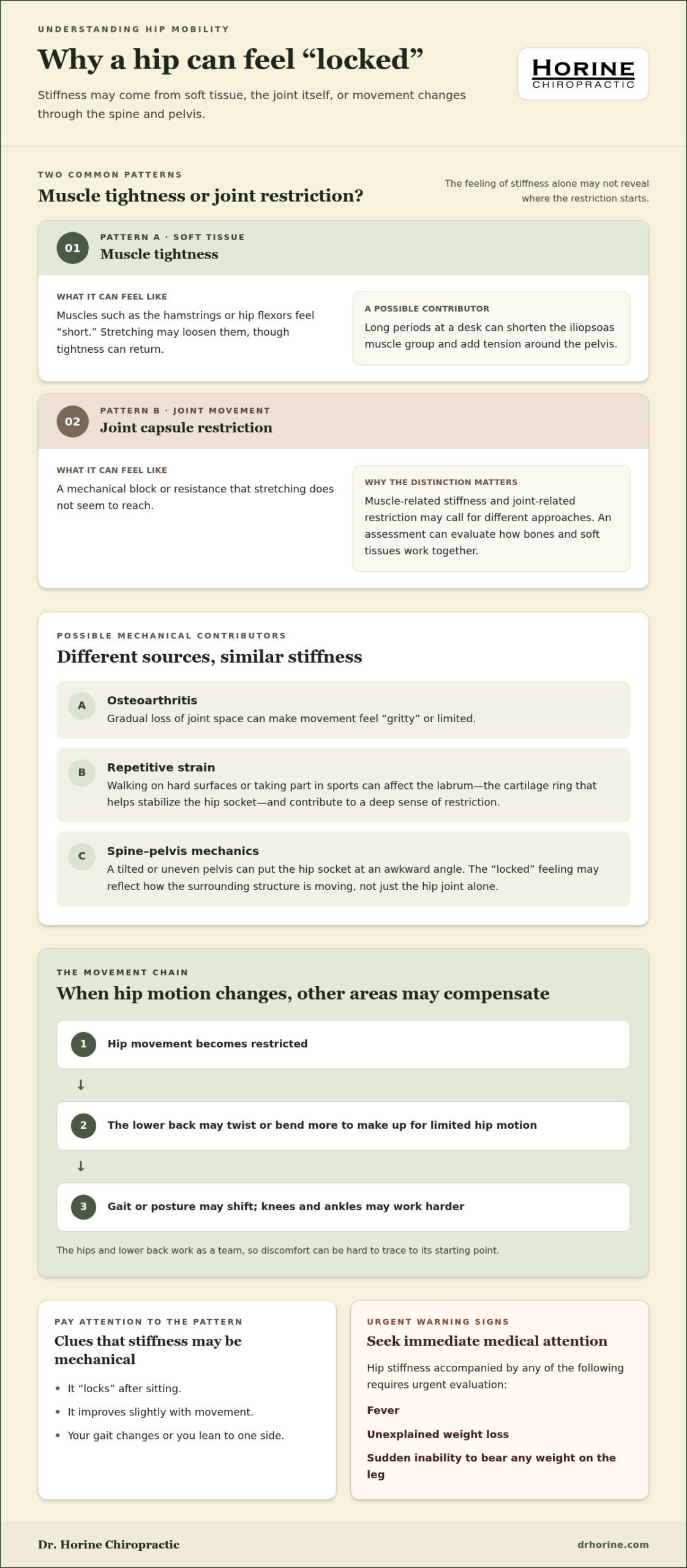
Soft tissue tightness usually involves muscles like the hamstrings or hip flexors feeling “short.” You can often stretch these out, even if they tighten back up later. Joint capsule restriction is different. It feels like a mechanical block, where no amount of stretching seems to reach the source of the resistance. Differentiating between these two is critical because a muscle problem requires a different approach than a joint problem. While most stiffness is mechanical, you should watch for certain red flags. If your stiffness is accompanied by a fever, unexplained weight loss, or a sudden inability to bear any weight on the leg, these are medical emergencies that require immediate attention. However, if the stiffness “locks” after sitting or improves slightly with movement, it’s likely a mechanical issue.
Maintaining hip health is also vital for your lower back longevity. Your hips and lower back work as a team. When your hips stop moving, your lower back has to twist and bend more to compensate. This extra work often leads to secondary spinal pain, making it difficult to tell where the problem actually started. Addressing the hips often provides the relief your back has been craving.
Common Causes of Mechanical Hip Stiffness
Modern life isn’t very kind to our hips. Spending hours at a desk leads to a shortened iliopsoas muscle group, which pulls on the pelvis and creates a constant state of tension. For others, the issue might be osteoarthritis, where the gradual loss of joint space makes movement feel “gritty” or limited. Repetitive strain from walking on hard surfaces or participating in sports can also affect the labrum, the ring of cartilage that stabilizes the socket, leading to a deep sense of restriction.
When Stiffness Becomes a Mobility Issue
Range of motion is the measurable degree of movement that a specific joint can achieve through its full path. When this measurement drops, your body starts to find “workarounds” to keep you moving. You might notice your gait changing or your posture leaning slightly to one side to avoid putting pressure on the stiff side. This leads to the compensation effect. Your knees and ankles often start to ache because they’re working overtime to make up for the lack of movement in your hips. Utilizing chiropractic for hip stiffness helps address these imbalances before they travel further down the leg.
The Spine-Pelvis Connection: Why Your Hips Feel ‘Locked’
Your hips don’t function in isolation. They’re part of a complex structural chain that begins in your lower back and continues through your pelvis. When patients seek chiropractic for hip stiffness, they’re often surprised to learn that the “locked” sensation in their joint is actually a symptom of a misaligned pelvis. If your pelvis is tilted forward or hiked to one side, the hip socket is no longer in its optimal position. This creates “false” stiffness where the joint feels restricted simply because it’s being forced to operate at an awkward angle. It’s like trying to close a door when the frame is crooked; no matter how much you oil the hinges, the door will still stick.
The Sacroiliac (SI) joint acts as the vital bridge between your spine and your hip. If this joint becomes stuck or inflamed, it disrupts the fluid transfer of weight as you walk. This dysfunction often forces the hip to overcompensate, leading to premature wear and a feeling of deep-seated tightness. Because of this mechanical link, seeking lower back pain relief Visalia is often the necessary first step in resolving hip issues. By stabilizing the foundation of the spine, we take the unnecessary pressure off the hip joints, allowing them to move freely again.
Pelvic Alignment and Gait Mechanics
An uneven pelvis forces one hip to work significantly harder than the other with every step you take. Over time, this pelvic rotation can create a functional leg length inequality, where one leg appears shorter than the other. This isn’t a bone problem, but a positioning problem that increases pressure within the hip socket. Stretching your hip flexors won’t fix this because you can’t stretch your way out of a structural pelvic misalignment. True relief requires a professional adjustment to bring the pelvis back into a neutral, balanced state.
Nerve Compression and Hip Function
The nerves that control your hip muscles originate in your lumbar spine, specifically at the L2 through L4 levels. If these nerve roots are compressed or irritated, the signals they send to your hip flexors become distorted. This often manifests as weakness or a persistent sense of tightness that doesn’t respond to massage. Nerve irritation can cause muscles to stay in a “guarded” or tight state as a protective mechanism. Even conditions like sciatica can contribute to perceived hip tightness, as the body limits motion to avoid further nerve pain. If you’re tired of feeling “stuck” in your own body, a thorough assessment of your spinal alignment is the best place to start.
Your Hip Health Checklist: Evaluating Your Need for Care
Before you decide on a course of action, it’s helpful to gather some data about how your body is actually behaving. You shouldn’t have to guess whether your stiffness is a minor muscle pull or a deeper structural issue. Using chiropractic for hip stiffness starts with a clear understanding of your baseline mobility. Pay close attention to your “Functional Movement” throughout the day. Does getting out of a low car seat feel like a chore? Do you find yourself bracing with your arms just to stand up from the sofa? These subtle changes in how you sit, stand, and squat are often the first indicators that your hip mechanics are shifting.
The 5-Point Stiffness Self-Assessment
Try these simple checks at home to see how your hips are currently performing. These aren’t meant to be a medical diagnosis, but they do provide a structured way to look at your movement patterns.
- Check 1: Sit in a sturdy chair and try to cross one ankle over the opposite knee. If you can’t get your leg into this “Figure 4” position comfortably, your joint rotation is likely restricted.
- Check 2: Take a ten minute walk around your neighborhood. Does the stiffness start to dissipate as you move, or does it feel like it’s getting tighter and more “pinched” with every step?
- Check 3: Listen to your body. Is there an audible “click” or “pop” when you move in a certain way? If that sound is accompanied by a sharp, catching pain, it suggests a mechanical blockage.
- Check 4: Notice if you feel a persistent urge to “pop” your hip for relief. This is a common sign of joint capsule tension.
- Check 5: Perform a shallow squat while holding onto a counter. If your hips shift to one side or you feel a “block” in the groin area, your pelvic alignment is likely involved.
Identifying Root Causes: Joint vs. Muscle
Tracking your pain patterns helps us determine where to focus our attention. If your stiffness is “joint-centric,” you’ll often feel a deep ache in the groin area and experience “locking” first thing in the morning. These symptoms usually mean the joint itself isn’t gliding properly within the socket. On the other hand, “muscle-centric” stiffness often feels like a tight band across the front of the thigh or the side of the hip. This type of tension usually feels better with heat and is tender when you press on the muscle directly. Chiropractic for hip stiffness is most effective when we can pinpoint exactly which structure is complaining. Consulting a chiropractor for joint pain is the most direct way to get a definitive diagnosis and move toward a solution that lasts.
How Chiropractic Care Restores Hip Mobility
The core objective of chiropractic for hip stiffness is to restore what we call “joint play.” This refers to the tiny, involuntary movements within a joint that allow for larger, smooth motions like walking or squatting. When this subtle play is lost, your body often responds by “locking” the area to prevent further irritation. Our approach is entirely non-invasive and drug-free, focusing on helping your body heal itself without the risks associated with surgery or long-term medication. By addressing the mechanical source of the restriction, we can help you move past the cycle of chronic tightness.
Our process begins with a careful evaluation of your unique movement patterns. We look at how your hip interacts with your pelvis and lower back to ensure we aren’t just treating a symptom. Once we identify the restriction, we use targeted adjustments to encourage the joint back into its proper alignment. This isn’t about force; it’s about precision. Many patients find that once the joint starts moving correctly, the chronic muscle guarding that has been making them feel “stuck” finally begins to melt away.
Manual Adjustments and Joint Mobilization
The science behind a chiropractic adjustment involves a phenomenon called cavitation. This is the release of gas bubbles within the joint fluid, which helps to increase the flow of synovial fluid. Think of this fluid as the natural lubricant that keeps your joints gliding smoothly. Adjustments reduce pressure on the femoral head within the socket, which immediately creates a sense of lightness and ease. For patients with sensitive joints or those dealing with osteoarthritis, we utilize gentle mobilization techniques. These methods prioritize your comfort while still achieving the goal of increasing joint space and improving circulation to the area.
Complementary Therapies for Hip Flexibility
While the adjustment addresses the joint, we also need to speak to the surrounding muscles. We often use trigger point therapy to address the gluteus medius and piriformis muscles. These specific muscles frequently stay in a state of “high alert” when your hip is stiff, creating deep-seated tension that stretching alone can’t reach. Releasing these trigger points allows the adjustment to hold longer and improves your overall flexibility. To maintain these results, we’ll guide you through specific strengthening exercises that support your new range of motion. Posture correction is also a vital part of the plan, as it prevents the return of hip stiffness by ensuring you aren’t putting uneven weight on your joints. If you’re ready to see how a personalized plan can help you, schedule your comprehensive hip assessment today and take the first step toward lasting relief.
Personalized Hip Care at Dr. Horine Chiropractic in Visalia
Choosing the right provider for your health is a significant decision, especially when your mobility is on the line. At Dr. Horine Chiropractic, we’ve spent decades perfecting an approach that prioritizes your comfort and clarity above all else. Since 1987, our practice has been a staple in the Visalia community, offering a space where patients feel heard rather than just processed. We understand that the fear of the unknown can be just as paralyzing as the physical pain itself. That’s why we emphasize a transparent, “No-Pressure” diagnostic assessment for every new patient exploring chiropractic for hip stiffness. Our goal is to lower your guard by providing honest answers and a clear path forward.
What to Expect at Your First Visalia Visit
Your journey begins with a comprehensive physical exam that goes far beyond a simple consultation. We take the time to test your specific range of motion and look for orthopedic signs that tell the story of your hip health. This methodical investigation helps us determine if your stiffness is a mechanical issue we can resolve or if it requires a different type of specialist. We value integrity, so if we find that our care isn’t the right fit for your condition, we’ll be the first to tell you and help point you toward the right resource.
If we can help, we’ll develop a customized plan focused on your specific life goals. We don’t believe in one-size-fits-all treatments. Instead, we tailor our protocols to what matters most to you, whether that is:
- Returning to the golf course without a “locking” sensation in your swing.
- Enjoying a morning walk through your neighborhood without stiffness.
- Tending to your garden without the fear of your hip “giving out.”
- Simply being able to put on your shoes and socks with ease.
Serving the Visalia Community for Over 35 Years
Local experience matters because it builds a foundation of trust that spans generations. We’ve served Visalia residents for over 35 years, and that longevity has given us a deep understanding of the lifestyle and needs of our neighbors. We aren’t a revolving door of practitioners; we’re a stable, reliable partner in your long-term wellness journey. We focus on achieving quick relief while also building a structural foundation that prevents your symptoms from returning. By choosing a local expert who treats people rather than just symptoms, you’re investing in a higher standard of personalized attention. It is time to stop worrying about the future of your mobility and start taking practical steps toward a more comfortable life. Schedule your hip stiffness assessment with Dr. Horine today and discover the difference that patient-centered care can make.
Take the First Step Toward Fluid Movement
You don’t have to accept a life of limited mobility or fear that a hip replacement is your only option. We’ve explored how hip stiffness is rarely an isolated problem; it’s often a structural chain reaction involving your lower back and pelvic alignment. By utilizing chiropractic for hip stiffness, you can address these root causes and restore the essential joint play needed for your favorite everyday activities.
Dr. Horine has been serving the Visalia community since 1987, bringing over 35 years of local expertise to every patient interaction. We focus on providing personalized diagnostic assessments that offer the clarity you need to move forward with confidence. Whether your goal is to return to the golf course or simply put on your shoes without struggle, we’re here to guide you toward a solution that works for your unique body. For those requiring extra assistance at home, resources like FIVESTEP 五步健 offer specialized products to support your rehabilitation journey. It’s time to stop guessing and start healing with a partner who truly listens to your concerns.
Schedule Your Hip Mobility Exam with Dr. Horine in Visalia today and rediscover what it feels like to move with ease. We look forward to helping you reach your mobility goals.
Can a chiropractor help with hip stiffness caused by arthritis?
Yes, chiropractic care can be highly effective for managing hip stiffness caused by osteoarthritis. While we cannot reverse the wear and tear on the joint, we focus on restoring as much motion as possible and reducing the surrounding muscle tension. By improving joint play and circulation, many patients find they can walk more comfortably and delay more invasive interventions. We always tailor our techniques to your specific comfort level and the severity of your arthritis.
How many sessions does it take to feel relief from hip stiffness?
Most patients begin to feel a noticeable improvement in their range of motion within three to five sessions. However, the exact timeline depends on how long you’ve been experiencing the stiffness and your body’s unique response to treatment. Our goal is to provide quick relief while working toward long-term wellness. We’ll evaluate your progress at each visit to ensure your personalized plan is moving you toward your mobility goals efficiently.
Is chiropractic care safe for patients who have had a hip replacement?
Chiropractic care is safe for those with hip replacements, provided we avoid direct high-force adjustments on the prosthetic joint itself. We focus our attention on the alignment of your lower back and pelvis, which often overcompensate after surgery. Balancing these areas helps reduce the strain on your artificial hip and improves your overall gait. It’s a gentle way to ensure your entire structural chain is working in harmony after a major procedure.
What is the difference between hip stiffness and sciatica?
Hip stiffness is generally a mechanical restriction within the joint or surrounding muscles, while sciatica involves irritation of the sciatic nerve. Sciatica often causes a radiating pain that travels down the leg, sometimes accompanied by numbness or tingling. In contrast, hip stiffness feels like a “locking” or limited range of motion centered in the groin or side of the hip. Using chiropractic for hip stiffness helps us distinguish between these two often-related conditions.
Will I need X-rays before my first hip adjustment?
You won’t necessarily need X-rays before your first adjustment, but we make that determination based on your physical exam and health history. If we suspect significant structural changes or want to rule out specific underlying conditions, we may recommend imaging for your safety. Our primary focus is a thorough diagnostic assessment to ensure we have a clear picture of your hip health before beginning any manual therapy or corrective care.
Can tight hip flexors cause lower back pain?
Tight hip flexors are a very common cause of lower back pain because they pull the pelvis into an anterior tilt. This tilt increases the arch in your lower back and puts excessive pressure on the spinal discs and joints. When you utilize chiropractic for hip stiffness, we often find that releasing these tight muscles provides immediate relief for the spine. Addressing the hips is often the missing link in resolving chronic back discomfort.
What should I wear to my first chiropractic appointment for hip pain?
We recommend wearing comfortable, loose-fitting clothing that allows for a full range of movement. Athletic wear, leggings, or loose trousers are ideal choices for your first visit. Since we’ll be performing a physical exam that involves moving your legs and checking your hip rotation, avoid restrictive fabrics like stiff denim or tight skirts. Our goal is to make your assessment as thorough and comfortable as possible while we evaluate your mobility.
Are there exercises I can do at home to help with hip stiffness?
There are several gentle stretches and mobility drills you can perform at home, such as the Figure 4 stretch or pelvic tilts. However, it’s best to wait until after your initial exam so we can recommend the specific movements that are safe for your condition. Performing the wrong exercise can sometimes aggravate a joint issue. Once we’ve identified the cause of your stiffness, we’ll provide a customized home plan to support your recovery.
Article by
Dr. Russell Horine, DC Chiropractor
Horine Chiropractic has established a strong reputation for delivering exceptional results in treating complex back and neck pain cases. Their primary objective is to serve patients efficiently and compassionately, aiding them in their journey to wellness. Horine Chiropractic uses a comprehensive, groundbreaking approach to treating stubborn back and neck pain. They have been helping Visalia’s backs, necks, and everything in between for a combined 45 years. They create a comprehensive approach to help their patients meet their health needs. Horine Chiropractic customizes treatment plans to meet each patient's unique health needs. The clinic is accepting new patients and providing compassionate care to those in need.
Medical Disclaimer
This content is provided for general educational and informational purposes only and is not intended as medical advice, diagnosis, or treatment. Individual conditions and treatment needs vary. Please consult a qualified healthcare professional regarding your specific symptoms and treatment options.