

What if the constant pressure behind your eyes and that tight, grinding sensation in your shoulders aren’t two separate problems, but actually the same physical alarm bell? It’s incredibly frustrating to wake up with a heavy head or struggle to check your blind spot while driving because you simply can’t turn your neck fully. You’ve likely tried different pillows or desk setups, yet that dull ache at the base of your skull always seems to return. When you deal with head pain and neck stiffness, it often feels like you’re just managing symptoms rather than finding a real solution.
We understand that cycle of discomfort and the desire for a clear, non-drug path to relief. This article will help you discover why these two issues are almost always connected through the delicate mechanics of your upper spine. We’ll look at the underlying causes of your tension and outline a structured approach to help you regain a normal, pain-free range of motion. It’s time to stop guessing whether it’s your posture or your pillow and start addressing the root cause of your pain.
Key Takeaways
- Learn how the nerves in your upper neck and head share a common pathway, explaining why head pain and neck stiffness often occur as a single mechanical issue.
- Discover the difference between standard tension headaches and neck-born cervicogenic headaches so you can target the right source of your discomfort.
- Understand how local lifestyle factors like Highway 99 commutes and Tech Neck add up to 60 pounds of pressure on your spine.
- Explore natural strategies for relief, including specific range-of-motion exercises and the role of hydration in relaxing stubborn neck muscles.
- See how a thorough diagnostic exam can uncover the root cause of your recurring symptoms to create a personalized path toward lasting comfort.
Why Head Pain and Neck Stiffness Often Occur Together
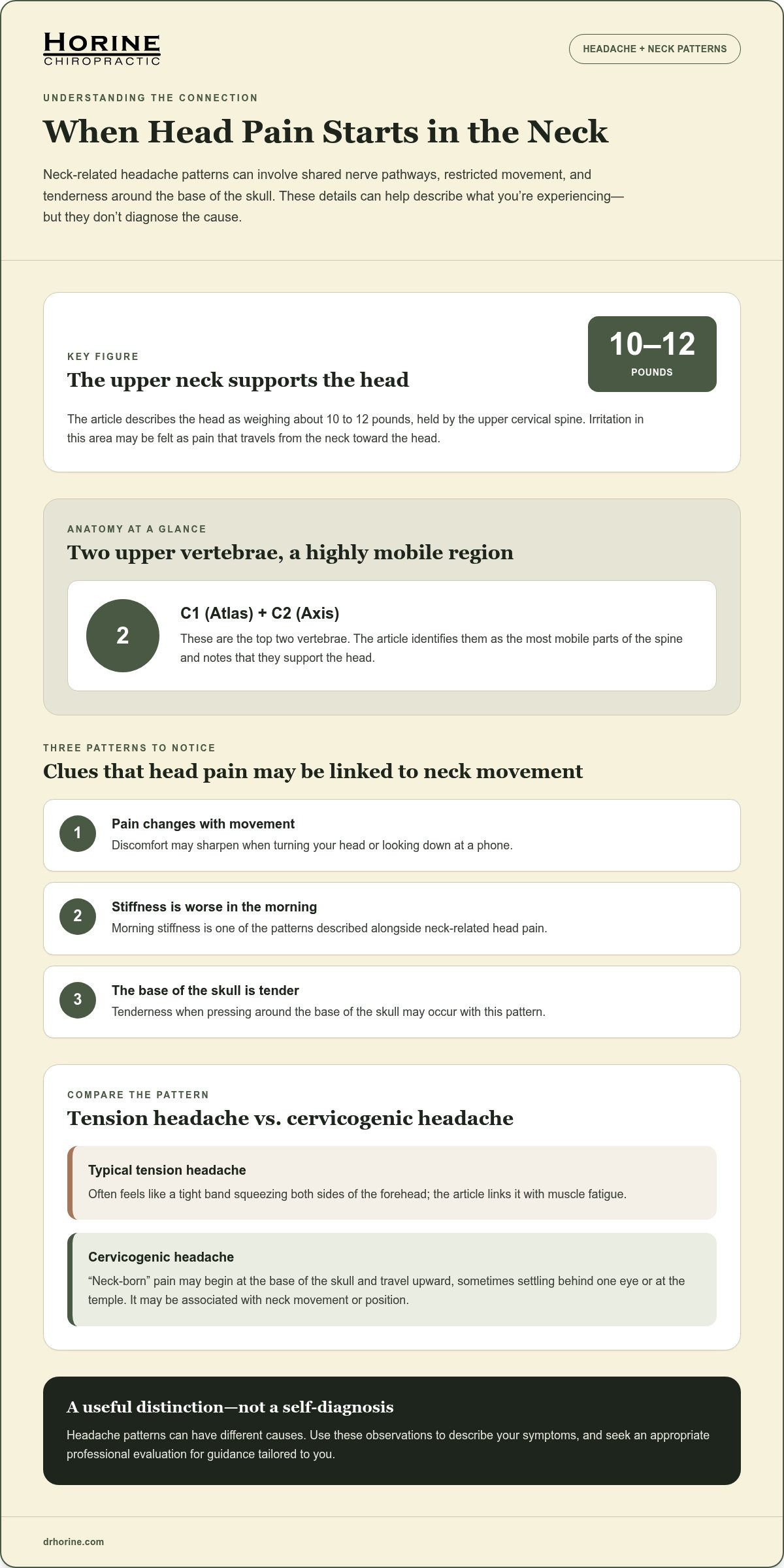
Many people treat their headaches and their stiff necks as two completely different problems. In reality, they’re often two sides of the same coin. The nerves in your upper neck share a communication pathway with the nerves that provide sensation to your head and face. When the joints in your neck are irritated, your brain can’t always tell exactly where the signal is coming from. This is called referred pain. It’s the reason a problem tucked away in your spine can feel like a tight vise squeezing your forehead or temples. The Cervical-Cranial Bridge is the primary link between neck stiffness and head pain.
If you find that your head pain and neck stiffness flare up at the same time, it’s a strong sign that the issue is mechanical. You can often test this yourself by noticing if the pain sharpens when you turn your head to check traffic or look down at your phone. When the problem is structural, symptoms usually follow a predictable pattern:
- Pain that increases with specific head or neck movements.
- Stiffness that feels worse first thing in the morning.
- Tenderness you can feel when pressing at the base of your skull.
The Role of the Upper Cervical Spine
Your top two vertebrae, the C1 (Atlas) and C2 (Axis), are the most mobile parts of your entire spine. They hold up the weight of your head, which is usually about 10 to 12 pounds. When these bones shift even slightly out of place, it puts immense pressure on the suboccipital muscles. Understanding Cervicogenic Headaches involves recognizing how these misalignments are often triggered by modern habits. Looking down at a screen for hours or sleeping on a pillow that doesn’t support the natural curve of your neck can easily disrupt this delicate balance.
Muscle Guarding and Chronic Tension
When a joint isn’t moving correctly, your body tries to protect itself through a process called muscle guarding, or “splinting.” Your muscles lock down to prevent further injury. While this is helpful for a short time, it creates a painful cycle. Tight muscles reduce blood flow, which leads to more stiffness and localized pain. Common trigger points in the trapezius and levator scapulae muscles often send sharp or dull aches directly to your temples. Addressing the mechanical source of head pain and neck stiffness is the only way to break this cycle and find lasting comfort.
Understanding Cervicogenic Headaches and Tension
Not all headaches are created equal. If you’ve spent years taking over-the-counter pain relievers with only temporary results, the problem might not be in your head at all. A cervicogenic headache is literally “neck-born.” While it often mimics the intense throbbing of a migraine, it’s actually a secondary headache. This means the pain is a symptom of an underlying mechanical issue in your cervical spine. Because the root cause is structural rather than chemical, traditional headache medicines usually fail to provide long-term relief.
It’s important to distinguish these from standard tension headaches. A typical tension headache usually feels like a tight band squeezing both sides of your forehead, often caused by simple muscle fatigue. In contrast, cervicogenic pain is tied to joint dysfunction. It typically starts as a dull ache at the base of the skull and migrates upward, often settling behind one eye or in the temple. When you struggle with head pain and neck stiffness, you’re likely dealing with a joint that isn’t moving correctly, sending “referred pain” signals into your skull. If you’re exploring your options, a comprehensive comparison of tension headache treatment options can help you understand which approach best targets the structural source of your pain.
Signs Your Headache is Actually a Neck Issue
How can you tell if your neck is the culprit? One of the most common signs is unilateral pain, meaning the headache stays primarily on one side. You might also notice that your pain is directly tied to your physical position. For instance, your symptoms might flare up after you’ve been staring at a computer or driving for a long period. This is why Modern Causes: Posture, Tech Neck are so frequently discussed by experts. You might also feel a “heavy” sensation in your head or realize your range of motion is limited, making it difficult to look over your shoulder.
The Stress-Neck-Headache Loop
Emotional stress often hides in your physical body. When you’re under pressure, your shoulders naturally creep up toward your ears. This constant shrugging irritates the nerves in your upper back and neck, creating a painful feedback loop. Stress leads to muscle guarding, which then causes joint misalignment and results in head pain and neck stiffness. If you simply “learn to live with” this cycle, the constant irritation can lead to chronic nerve compression. Breaking this loop requires more than just relaxation; it requires restoring proper movement to the spine. If you’re tired of the cycle, you can book an appointment online to have a professional evaluate your spinal health and find a path toward lasting comfort.
Modern Causes: Posture, Tech Neck, and Visalia Lifestyles
Living in the Central Valley often involves physical demands that we don’t always consider until the pain becomes impossible to ignore. Whether you’re navigating the heavy morning fog on Highway 99 during a commute to Fresno or working long shifts in Visalia’s bustling agricultural and healthcare sectors, your body is under constant strain. These daily habits create micro-traumas, small, repetitive stresses that accumulate over years. While a single long drive might only cause temporary tightness, a decade of that same posture can lead to chronic head pain and neck stiffness.
One of the most significant modern culprits is “Tech Neck.” When you stand with perfect posture, your head weighs about 10 to 12 pounds. However, as you tilt your head forward to look at a smartphone or tablet, the effective weight on your cervical spine increases dramatically. At a 60-degree angle, your neck is supporting roughly 60 pounds of pressure. This constant heavy lifting for your spine often results in a cervicogenic headache, where the source of the pain is actually the structural strain in your neck rather than a problem in the head itself.
The 42-Pound Head: The Physics of Poor Posture
Forward Head Posture isn’t just about looking slumped; it’s a mechanical failure that changes your anatomy. When your head drifts forward, the muscles at the back of your neck have to work overtime to keep you from toppling over. This overstretches the posterior muscles and compresses the joints in the upper spine. Over time, this can lead to a loss of lordosis, which is the natural C-shaped curve of your neck. Without that curve to act as a shock absorber, every bump in the road or hour at a desk contributes to recurring head pain and neck stiffness.
Workplace Ergonomics for Central Valley Residents
Many Visalia residents try to fix the problem with expensive “ergonomic” chairs, but these tools only work if your spine is already aligned. For desk workers, your monitor should be at eye level so your chin doesn’t tuck toward your chest. If you work in manual labor or nursing, “micro-breaks” are essential. Spend thirty seconds every hour gently rolling your shoulders back and down to reset your posture. For those long drives to Bakersfield, use a small lumbar roll or even a rolled-up towel behind your lower back. This supports the natural curves of your spine and prevents your head from jutting forward as you drive.
Natural Strategies for Relieving Stiffness and Pressure
Finding relief at home starts with understanding that your muscles often act as a protective barrier around your spine. When your joints are misaligned, your muscles tighten to prevent further injury. While this “guarding” is a natural defense, it often leads to a cycle of discomfort. You can support your body’s healing process by focusing on basic physiological needs like hydration and mineral balance. Muscles require water and electrolytes to function; dehydrated tissue loses its elasticity, which significantly contributes to head pain and neck stiffness. Many people find that increasing magnesium intake through leafy greens or supplements helps calm the nervous system and reduces those stubborn muscle spasms at the base of the skull.
Temperature therapy is another effective tool, provided you use the right one at the right time. If your pain is sharp, hot to the touch, or follows a recent injury, ice is usually the best choice to calm inflammation. However, for that heavy, dull ache that makes your neck feel like concrete, gentle heat is often more effective. Heat increases blood flow to the area, helping to flush out the lactic acid buildup that occurs in chronically tight muscles. Additionally, take a look at your sleep environment. Your pillow should support the natural C-curve of your neck rather than just being a soft place to rest. If your pillow is too high, it pushes your head forward all night, mimicking the same “tech neck” posture you’re trying to avoid during the day.
At-Home Stretches for Immediate Relief
Specific, gentle movements can help “unlock” the upper cervical joints and provide temporary relief. The Chin Tuck is one of the most effective exercises for realigning the head over the shoulders. Sit tall and pull your chin straight back, as if you’re making a double chin, without tilting your head up or down. You can also target the upper trapezius by gently tilting your ear toward your shoulder until you feel a pull along the side of your neck. For a deeper release, place a rolled-up towel at the base of your skull while lying on a flat surface. This suboccipital release helps relax the tiny muscles that are often the primary culprits behind tension-style headaches.
When to Stop Self-Treating and See a Professional
While home care is helpful, it shouldn’t be a permanent substitute for a structural correction. If you find yourself constantly “symptom masking” with over-the-counter pills or spending hours every day stretching just to feel normal, it’s a sign that the root cause hasn’t been addressed. There are also specific red flags that require immediate professional attention, such as numbness or tingling traveling down your arms, frequent dizziness, or pain that wakes you up in the middle of the night. Chronic head pain and neck stiffness often stem from a joint that is physically stuck and requires a precise adjustment to move correctly again. Many patients discover that spinal adjustment for headaches provides the drug-free, structural correction that home stretching alone cannot achieve. If your daily stretches aren’t providing lasting relief, you can schedule a specialized neck and headache exam to find out exactly why your symptoms keep returning.
Professional Care for Lasting Relief in Visalia
When home stretches and ergonomic changes aren’t enough, it’s usually because the mechanical issue in your spine has become “stuck.” At Dr. Horine Chiropractic, we’ve served the Visalia community since 1987, helping our neighbors find a clear path back to comfort. Our approach to headache relief Visalia CA is based on a simple but vital principle: we find the “why” before we ever decide on the “how.” We treat people rather than just symptoms, and that starts with a thorough, unhurried understanding of your unique physical history.
Manual spinal adjustments are the cornerstone of this process. Unlike a chemical solution that simply masks a signal, an adjustment restores the natural glide and mobility to joints that have been compressed by years of driving or heavy labor. This gentle approach helps calm the nervous system and allows the muscles at the base of your skull to finally release their grip. By restoring proper alignment, we address the root cause of head pain and neck stiffness, ensuring that your relief is both deep and lasting. For a deeper understanding of how this works, our guide on spinal adjustment for headaches as a natural path to lasting relief explains the process in detail. We respect your time and your health goals, creating a personalized plan that moves at a pace you’re comfortable with.
The Dr. Horine Diagnostic Process
Your first visit is a methodical investigative process designed to remove uncertainty. We don’t believe in high-pressure sales or overwhelming you with complex medical jargon. Instead, we perform a detailed diagnostic exam to identify the specific spinal segments that are causing your discomfort. We look for the exact points where the communication between your neck and head is breaking down. This commitment to honest, transparent care means you’ll leave your initial assessment with a clear understanding of your condition and a structured path toward resolution.
Beyond the Adjustment: Long-Term Wellness
True relief doesn’t end when you walk out of our doors. We position ourselves as your partner in health, combining professional chiropractic care with practical lifestyle advice tailored to life in the Central Valley. Whether it’s fine-tuning your posture for those long hauls on the 99 or suggesting specific movements to counteract a day at a desk, we want to prevent the pain from returning. Restoring your neck mobility does more than just stop an ache; it improves your overall quality of life and helps you reclaim your daily energy. If you’re ready to move toward a pain-free range of motion, Contact Dr. Horine Chiropractic for a consultation.
Reclaiming Your Comfort and Mobility
Understanding that your recurring head pain and neck stiffness likely stem from a mechanical issue in your upper spine is the first step toward lasting relief. Whether your discomfort is caused by the physical toll of Central Valley labor or the repetitive strain of your daily commute, you don’t have to settle for temporary fixes. By addressing the structural root cause rather than just masking symptoms, you can return to a normal, pain-free range of motion. It’s about finding a functional solution that lasts.
Since 1987, our practice has served Visalia families with personalized, unhurried treatment plans designed for real results. As a neck pain specialist Visalia patients rely on, Dr. Horine focuses on thorough diagnostics to ensure every patient feels heard and understood. You deserve a healthcare partner who values integrity and practical improvement over high-pressure tactics. Take the first step toward a clearer, more comfortable future today.
Schedule Your Diagnostic Exam with Dr. Horine in Visalia and discover the clarity that comes from expert, patient-centered care. We look forward to helping you move freely again.
Frequently Asked Questions
Can a stiff neck actually cause a migraine?
Yes, neck dysfunction can trigger or worsen migraine episodes. Research shows that more than 70% of migraine sufferers also experience neck pain before or during an attack. The nerves in the upper cervical spine share communication pathways with the trigeminal nerve, which is heavily involved in migraine activity. When your neck joints are restricted, they send irritation signals that can lower your threshold for a migraine, making the two conditions closely linked.
How many chiropractic sessions do I need for headache relief?
The number of sessions varies because every personalized treatment plan is tailored to your specific history and health goals. Some patients feel a significant difference after just a few visits, while chronic cases might require a more structured plan over several weeks to stabilize the spine. We focus on an honest assessment during your first visit to outline exactly what to expect, ensuring our approach is unhurried and focused on your long-term comfort.
Is it safe to have my neck adjusted if I have a headache?
It is generally safe and often highly effective to receive an adjustment while experiencing a headache. In fact, many patients seek care specifically during an active flare-up for immediate relief from the pressure. A professional exam identifies if your head pain and neck stiffness are caused by a mechanical misalignment. If the source is structural, a gentle adjustment can help restore mobility and reduce the intensity of your current symptoms.
Why does my head pain get worse after sitting at a computer all day?
Prolonged sitting often leads to “Tech Neck,” which places up to 60 pounds of extra pressure on your cervical spine. When you lean forward to look at a screen, the muscles at the base of your skull have to work overtime to support your head. This constant strain leads to muscle fatigue and joint irritation. This mechanical stress is a primary driver for the head pain and neck stiffness many office workers feel by the afternoon.
What is the best sleeping position for neck stiffness and head pain?
Sleeping on your back or your side is typically the best way to maintain the natural curve of your spine. Back sleepers should use a pillow that supports the neck’s contour without pushing the head too far forward. Side sleepers need a pillow thick enough to keep the head level with the shoulders. We recommend avoiding stomach sleeping, as it forces your neck into a strained, rotated position for hours, often leading to morning stiffness.
Can a chiropractor help with tension headaches even if they are caused by stress?
Yes, because stress often manifests as physical tension in the shoulders and upper back. This “shoulder shrugging” habit irritates the cervical joints and nerves, creating a physical loop of pain. While the trigger might be emotional, the result is a mechanical restriction in your spine. A chiropractor helps by breaking this cycle, relaxing the guarded muscles and restoring proper joint function so your body can better handle the physical effects of stress. Understanding your full range of tension headache treatment options can help you choose the most effective approach for your specific situation.
What is a cervicogenic headache and how is it different from a regular one?
A cervicogenic headache is a “secondary” headache, meaning the pain is actually referred from a problem in the neck joints or muscles. Unlike a primary headache like a migraine, which is often chemical or vascular, a cervicogenic one is purely structural. It typically feels like a dull ache starting at the base of the skull and moving toward one eye. It is often triggered by specific neck movements or sustained poor posture at a desk.
When should I be worried about head pain and neck stiffness?
You should seek a professional evaluation if your symptoms are accompanied by red flags like numbness in the arms, dizziness, or sudden weakness. If your pain follows a specific injury or doesn’t improve with rest and basic stretching, it’s time for a diagnostic exam. We focus on finding the “why” behind your symptoms to ensure there isn’t a more serious underlying issue, providing you with clarity and a safe path toward recovery.
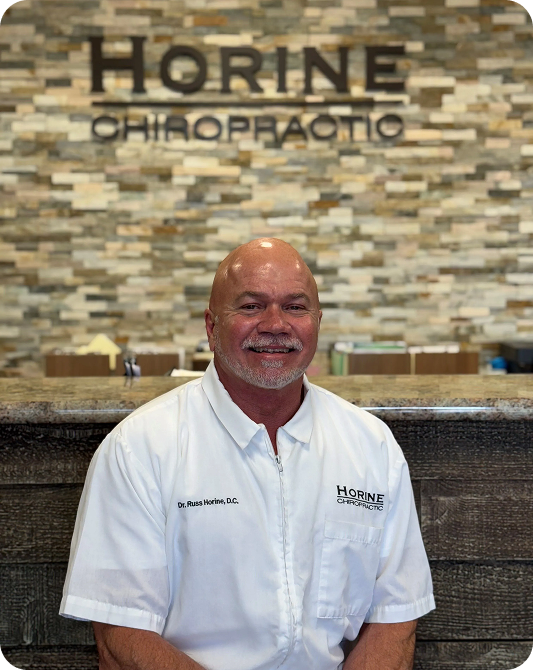
Article by
Dr. Russell Horine, DC Chiropractor
Horine Chiropractic has established a strong reputation for delivering exceptional results in treating complex back and neck pain cases. Their primary objective is to serve patients efficiently and compassionately, aiding them in their journey to wellness. Horine Chiropractic uses a comprehensive, groundbreaking approach to treating stubborn back and neck pain. They have been helping Visalia’s backs, necks, and everything in between for a combined 45 years. They create a comprehensive approach to help their patients meet their health needs. Horine Chiropractic customizes treatment plans to meet each patient's unique health needs. The clinic is accepting new patients and providing compassionate care to those in need.
Medical Disclaimer
This content is provided for general educational and informational purposes only and is not intended as medical advice, diagnosis, or treatment. Individual conditions and treatment needs vary. Please consult a qualified healthcare professional regarding your specific symptoms and treatment options.