

Imagine waking up to a sharp, stabbing sensation that makes even the simplest glance at your alarm clock feel like a feat of endurance. You try to turn your head, but a sudden restriction stops you cold, leaving you wondering how you’ll manage to drive safely or focus through a dull ache radiating into your shoulders. It’s a frustrating way to start the day, especially when you feel like your own bed has betrayed you. Since research shows between 60% and 80% of people will experience neck pain at some point in their lives, you’re certainly not alone in this struggle.
We understand how unsettling it feels when your range of motion is suddenly cut in half, and we’re here to help you move freely again. Finding a reliable stiff neck after sleeping fix doesn’t have to involve guesswork or high-pressure tactics. You deserve a clear path to relief that addresses both the immediate discomfort and the underlying cause. In this guide, we’ll explore the mechanical reasons why your neck locks up overnight, provide a logical sequence of movements for quick relief, and explain how the right sleeping environment can prevent these painful mornings from returning for good.
Key Takeaways
- Learn how facet joint irritation and prolonged static posture cause your neck muscles to lock up while you sleep.
- Discover why gentle heat and the “Micro-Movement” technique provide a faster stiff neck after sleeping fix than traditional ice packs.
- Identify your “Goldilocks” pillow height to maintain proper spinal alignment whether you prefer sleeping on your side or your back.
- Understand the “48-Hour Rule” and specific red flags that signal when it is time to seek a professional diagnostic assessment.
Why You Wake Up with a Stiff Neck: The ‘Fix’ Starts with Understanding
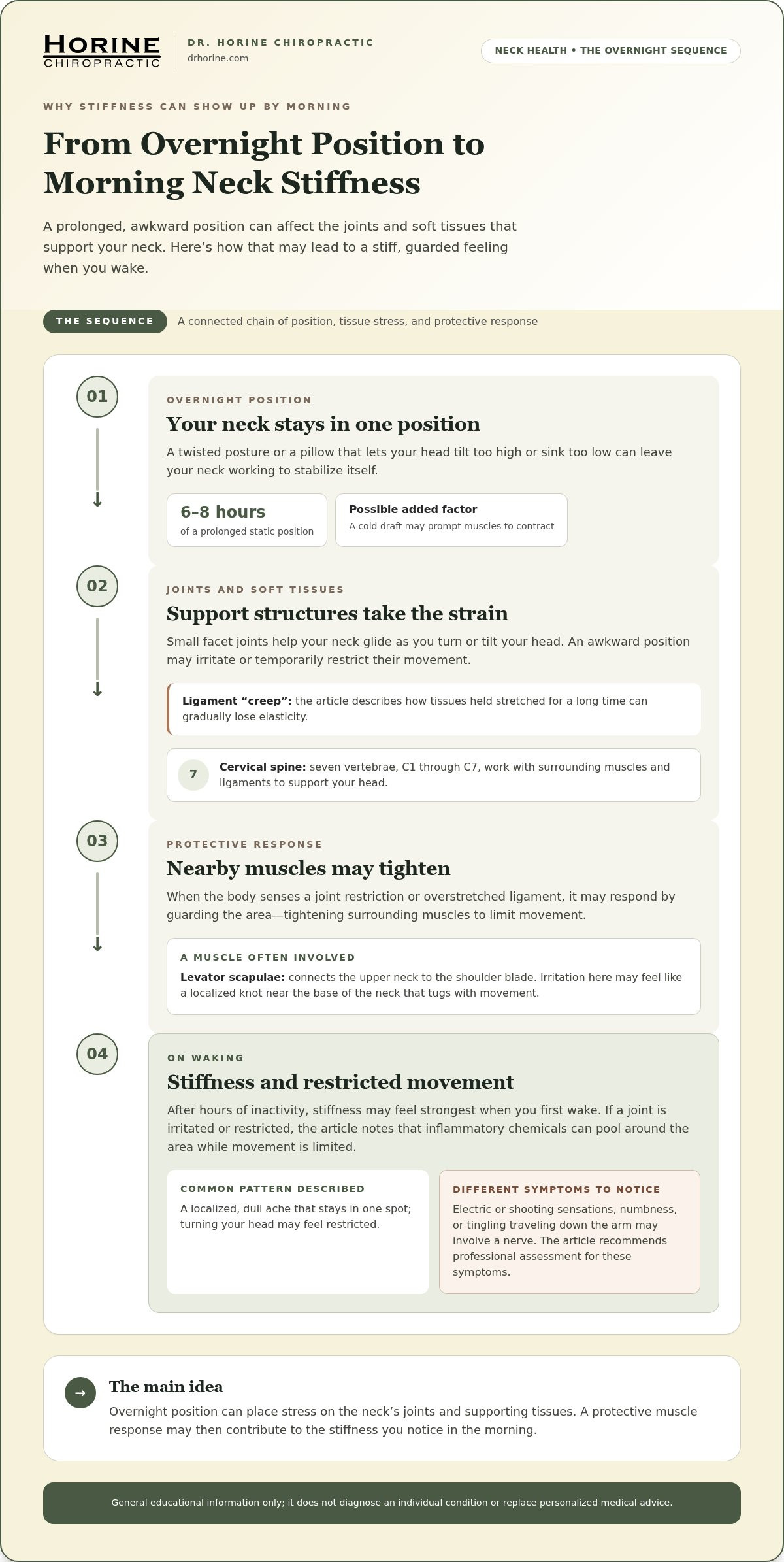
Waking up with a rigid neck isn’t a disease; it’s rarely a sign of something sinister. It is usually a mechanical issue where your body has entered a state of acute muscle guarding. This happens when your brain senses a joint is out of alignment or a ligament is overstretched. In response, it tells the surrounding muscles to lock down to prevent further injury. You might also be experiencing a minor joint subluxation, where the small joints in your spine aren’t gliding as they should. Understanding this is the first step toward a stiff neck after sleeping fix because it shifts the focus from a medical mystery to a mechanical resolution.
One of the primary culprits is prolonged static posture. Your neck isn’t meant to stay in a single, twisted position for six to eight hours. When it does, your cervical ligaments lose their elasticity through a process known as creep, where tissues slowly stretch and fail to return to their original shape. Even the temperature in your bedroom plays a role. A cold draft from an open window or a ceiling fan can cause your muscles to involuntarily contract overnight. This protective reflex often leaves you with significant Neck stiffness when you finally try to move in the morning.
The Role of the Levator Scapulae
The levator scapulae is the most common muscle involved in morning stiffness. It connects the upper part of your neck directly to your shoulder blade, acting as a bridge for movement. If you feel a sharp, localized knot at the base of your neck that seems to pull every time you move your arm, this muscle is likely the source. Because it helps rotate your head and shrug your shoulders, any inflammation here makes basic tasks feel nearly impossible. It essentially acts like a guy-wire that has been pulled too tight for too long, resulting in that familiar, agonizing tug.
Micro-Trauma During Sleep
Sleep isn’t always peaceful for your musculoskeletal system. Sudden movements during vivid dreams can strain muscles that are in a relaxed, vulnerable state. This is often exacerbated by an unsupportive pillow that fails to keep your spine neutral. When your head is tilted too high or allowed to sink too low, your muscles must work throughout the night to stabilize your neck. This is a mechanical failure of support, not a medical mystery. By morning, the overworked tissue is inflamed, exhausted, and locked in a protective spasm that makes the simplest movements painful.
The Anatomy of Morning Neck Pain
Your cervical spine is a masterpiece of flexibility, but that very mobility makes it prone to trouble. It consists of seven small vertebrae, known as C1 through C7, which work together to support your head. Because these bones are so mobile, they rely heavily on surrounding ligaments and muscles for stability. When you sleep in a way that compromises this stability, the system can quickly break down. This vulnerability is why finding a reliable stiff neck after sleeping fix starts with respecting the delicate balance of your neck’s structure.
Small joints called facet joints sit between each of your vertebrae. These joints are lined with cartilage and allow your neck to glide smoothly as you turn or tilt your head. If you spend hours in an awkward position, these joints can become “stuck” or irritated. This mechanical restriction is the physical block you feel when you try to look over your shoulder in the morning. It isn’t just in your head; the joint itself is temporarily restricted.
Many people don’t realize that neck stiffness is a primary trigger for tension headaches. The nerves in the upper part of your neck (C1 through C3) share a common pathway with the nerves that provide sensation to your head and face. When these joints are locked, the resulting irritation can refer pain upward, leaving you with a dull, throbbing sensation behind your eyes or at the base of your skull.
While you sleep, your body’s circulation naturally slows down. If there’s a minor injury or joint restriction, inflammatory chemicals can pool around the affected area because there isn’t enough movement to flush them out. This chemical buildup is why your pain often feels most intense the moment you open your eyes. It takes time and deliberate movement to clear this “stagnant” fluid and restore comfort.
Nerve Compression vs. Muscle Strain
It’s vital to distinguish between a simple muscle pull and something involving your nerves. A muscle strain usually feels like a dull, localized ache that stays in one spot. If you feel sharp, electric sensations, numbness, or tingling that travels down your arm, a nerve might be involved. We call this radiculopathy, which is the medical term for when a nerve root in your spine is compressed or irritated. If you’re experiencing these shooting sensations, seeking professional neck pain treatment is a smart next step to ensure the nerve isn’t being further damaged.
Inflammation and Blood Flow
Stiffness is often at its peak first thing in the morning because your muscles have been inactive for hours. Think of your muscles like a sponge that has dried out; they become brittle and lose their ability to stretch. Gentle movement acts as a natural pump, bringing fresh, oxygenated blood to the area to “thaw” the stiffness. This process of increasing blood flow is the most effective natural way to reduce the chemical inflammation that built up while you were resting.
Immediate Fixes: How to Loosen a Stiff Neck Fast
When you’re searching for a stiff neck after sleeping fix, your primary goal is to lower the intensity of that initial muscle guarding. You don’t need to force a full range of motion right away. Instead, focus on calming the nervous system so it releases the “lock” on your cervical spine. Follow these logical steps to begin the thawing process safely.
- Step 1: Apply Gentle Heat. While ice is great for new injuries like a sports sprain, morning stiffness usually responds better to heat. A warm shower or a heating pad on a low setting for 10-15 minutes encourages blood to return to those “dried out” muscle fibers. This relaxes the tissue enough to begin moving.
- Step 2: The Micro-Movement Technique. Avoid the temptation to do big, sweeping neck rolls. These can actually pinch the facet joints we discussed earlier. Instead, imagine drawing a circle with your nose the size of a nickel. These tiny, controlled rotations lubricate the joints without triggering a protective spasm.
- Step 3: Target the Levator Scapulae. Reach across your body and find the tight “knot” where your neck meets your shoulder blade. Apply steady, gentle pressure with two fingers for 30 seconds while breathing deeply. You’re not trying to “break” the knot; you’re simply asking the muscle to let go.
- Step 4: Strategic Hydration. Drink 8-12 ounces of water immediately. Your spinal discs and muscle fascia need hydration to remain pliable. If you’re dehydrated, your recovery will be significantly slower.
- Step 5: Balance Rest and Motion. Avoid sitting still for long periods, which allows inflammation to pool. Take a five-minute walk every hour to keep your circulation moving, but skip the gym or heavy lifting until your range of motion returns.
Safe Morning Stretches for Neck Relief
Once you’ve applied heat, you can try specific, low-impact stretches. Start with the Chin Tuck: sit tall and gently pull your chin straight back, as if you’re closing a drawer with your face. You should feel a light pull at the base of your skull. Next, try Side-to-Side Ear Drops by slowly tilting your right ear toward your right shoulder until you feel a gentle stretch on the left side. Hold each of these for only 5-10 seconds. Holding longer can actually trigger a “stretch reflex,” causing the muscle to tighten even further in self-defense.
The ‘No-Go’ Zone: What NOT to Do
It’s just as important to know what to avoid. Never try to “crack” your own neck to find relief. While it might provide a temporary sensory distraction, self-manipulation can strain your ligaments and lead to long-term instability. You should also avoid aggressive stretching that causes sharp, stabbing pain. If a movement makes you wince, your body is telling you to stop. Finally, don’t rely solely on topical numbing creams. While they can dull the ache, they don’t address the mechanical joint restriction or muscle guarding that caused the problem in the first place.
Preventing the Morning ‘Kink’: Pillows and Positions
The most effective stiff neck after sleeping fix isn’t a stretch you do in the morning; it’s the environment you create before you close your eyes. If you find yourself constantly battling a “kink” in your neck, your sleep setup is likely working against your anatomy. Think of your bed as a cockpit for your spine. Every element needs to be calibrated to keep your head, neck, and shoulders in a neutral line, preventing the muscle guarding we discussed earlier.
Stomach sleeping is the primary enemy of a healthy neck. When you lie on your belly, you’re forced to turn your head 90 degrees to breathe. Staying in this twisted position for hours places immense strain on the C1 through C7 vertebrae and overstretches the ligaments on one side of your neck. If you can’t break the habit, try using a very thin pillow or no pillow at all to reduce the angle of the twist. However, transitioning to your side or back is the best move for long-term relief.
Side sleepers and back sleepers have different ergonomic requirements. If you’re on your side, your pillow must be thick enough to fill the entire gap between your ear and the tip of your shoulder. This prevents your head from “hanging” and pulling on the levator scapulae. Back sleepers, on the other hand, need a thinner pillow that supports the natural curve of the neck without pushing the chin toward the chest. The goal is a “Goldilocks” height: not too high, not too low, but just enough to keep your nose aligned with your sternum.
Choosing the Right Pillow in 2026
Modern pillow technology offers two great options: memory foam and contoured designs. Memory foam is excellent because it adapts to your specific shape, providing consistent support that doesn’t “bottom out” overnight. Contoured pillows are specifically molded with a “valley” for your head and a “hill” for your neck, which is ideal for maintaining the cervical curve. Regardless of the material, you should replace your pillow every 18 to 24 months. Over time, the internal structure breaks down, and it can no longer provide the structural support your spine requires.
Sleep Hygiene for Spinal Health
Your environment also dictates how your muscles behave. Keep your bedroom temperature between 65 and 68 degrees to encourage deep sleep, but ensure you aren’t in the direct path of a cold draft. As we noted, cold air can cause muscles to contract involuntarily. Before you drift off, use this quick checklist: ensure your shoulders are off the pillow, your neck is fully supported, and your spine feels “long.” If these adjustments don’t stop the cycle of morning pain, it’s time for professional neck pain treatment to identify any underlying mechanical issues that ergonomics alone can’t fix.
When a Stiff Neck Needs Professional Care in Visalia
While home remedies like gentle heat and micro-movements are excellent first steps, they aren’t always enough to resolve a deep-seated mechanical issue. Finding a reliable stiff neck after sleeping fix often starts at home, but sometimes the body needs a little extra help to reset. If you’ve been struggling for more than two days, it’s time to consider the “48-Hour Rule.” This rule is simple: if your range of motion hasn’t significantly returned or your pain levels remain high after 48 hours of home care, your body is likely dealing with a joint restriction that requires a professional assessment from an evidence-based clinic like Russell Health Collective.
Whether you are local to our clinic or searching for a family-centered chiropractor inner west sydney, finding a practice that specializes in pediatric and pregnancy care can ensure that every member of the family maintains optimal spinal health and mobility.
There are also specific red flags that demand immediate attention. If your neck stiffness is accompanied by any of the following, you shouldn’t wait:
- A high fever or sudden chills.
- A severe, unusual headache that feels different from a typical tension ache.
- Numbness or a loss of strength in your arms or hands.
These symptoms can indicate issues beyond simple muscle guarding and require a thorough diagnostic exam to ensure your safety. We focus on listening to your concerns first to rule out these serious complications before moving forward with a structured plan.
At our clinic, we’ve served the Visalia community since 1987. We believe in an honest, patient-centered approach that treats you like a neighbor rather than just a set of symptoms. A chiropractic adjustment is often the missing piece in your stiff neck after sleeping fix because it restores mobility to the facet joints that you simply can’t reach on your own. By gently realigning the cervical spine, we remove the interference that keeps your muscles in a state of constant spasm.
What to Expect at Dr. Horine Chiropractic
Our diagnostic process is methodical and unhurried. We focus on finding the “why” behind your stiffness rather than just masking the pain. During your visit, we’ll perform a detailed physical exam to identify exactly which joints are restricted. Learn about our first-visit chiropractic exam to see how we build a roadmap for your recovery. Our adjustments are gentle and tailored to your specific comfort level, ensuring you feel heard and understood throughout the process.
Long-Term Wellness Beyond the Fix
Recovery doesn’t end when the pain stops. For many desk workers in Visalia offices, poor ergonomics can lead to a recurring cycle of morning stiffness. We work with you on posture correction and periodic maintenance to ensure your spine remains resilient. This proactive approach helps prevent minor “kinks” from turning into chronic, debilitating issues. If you’re ready to move without restriction, schedule your neck pain assessment with Dr. Horine today and take the first step toward lasting relief.
Restore Your Mobility and Reclaim Your Mornings
Waking up with a restricted neck is a clear signal that your spinal mechanics need attention. We’ve explored how understanding your anatomy, applying gentle heat, and optimizing your sleep environment can provide relief. However, remember that home care is most effective when it addresses the underlying joint restrictions that cause these recurring spasms. Finding a lasting stiff neck after sleeping fix often requires moving beyond temporary relief to restore proper alignment.
Since 1987, our practice has provided honest, patient-centered care to the Visalia community. We specialize in neck and spine health, offering a neighborly environment where your recovery is our priority. You deserve to start your day feeling refreshed rather than restricted by sharp pain. If you’re ready to stop the cycle of morning stiffness, we’re here to guide you toward a more comfortable, active lifestyle.
Wake up without pain; book your gentle neck adjustment at Dr. Horine Chiropractic
Take that first step today and look forward to a morning where you can move freely and without hesitation.
Frequently Asked Questions
How long does a stiff neck from sleeping usually last?
Most cases of morning stiffness resolve within 48 to 72 hours with proper home care and gentle movement. If the pain persists beyond a week, it often indicates a deeper mechanical restriction that won’t clear on its own. We recommend following the “48-Hour Rule” we discussed; if you don’t see noticeable improvement in two days, it’s time for a professional assessment to find the cause.
Is it better to use heat or ice for a stiff neck?
Heat is usually the preferred choice for morning stiffness because it relaxes tight muscles and increases blood circulation to “thaw” the area. Ice is better suited for acute injuries with visible swelling, like a sports impact or a fall. For a reliable stiff neck after sleeping fix, try a warm shower or a heating pad on a low setting for 15 minutes to help the tissue loosen.
Can a bad pillow really cause permanent neck damage?
A single night on a bad pillow won’t cause permanent structural damage, but chronic poor support leads to long-term wear and tear. Over many years, an unsupportive pillow can accelerate degenerative changes in the cervical spine by keeping your joints in a strained position. Replacing your pillow every 18 to 24 months ensures your neck stays in a neutral position, protecting your joints from unnecessary stress.
Should I keep moving my neck if it hurts, or should I wear a brace?
You should keep moving your neck using gentle, pain-free ranges of motion rather than wearing a brace. Braces can actually make the problem worse by allowing the supporting muscles to become weak and inactive. Stick to the “Micro-Movement” technique we covered earlier, keeping the circles small and controlled to maintain circulation without overstretching the irritated tissue or triggering more guarding.
Can stress make me wake up with a stiffer neck?
Stress is a major contributor to morning stiffness because it causes you to subconsciously clench your jaw and shrug your shoulders while you sleep. This tension keeps your muscles in a state of constant contraction throughout the night, leading to exhaustion and inflammation by morning. Practicing a brief relaxation routine or gentle decompression stretches before bed can help lower your baseline tension and prevent waking up in pain.
When should I worry that my neck pain is something more serious?
You should seek immediate care if your stiffness is accompanied by a high fever, a sudden and severe headache, or a loss of strength in your arms. These “red flags” suggest the issue might be more than a simple muscle strain or joint restriction. While between 60% and 80% of people face common neck pain, these additional symptoms require a thorough diagnostic exam to rule out serious underlying conditions.
How many chiropractic sessions does it take to fix a stiff neck?
Every person’s recovery timeline is unique, but many patients feel a significant reduction in pain after just one to three sessions. The initial focus is on restoring joint mobility and calming the surrounding muscle guarding to provide a fast stiff neck after sleeping fix. Once the acute stiffness is resolved, we often discuss a personalized plan to address any underlying postural habits that might cause the pain to return.

Article by
Dr. Russell Horine, DC Chiropractor
Horine Chiropractic has established a strong reputation for delivering exceptional results in treating complex back and neck pain cases. Their primary objective is to serve patients efficiently and compassionately, aiding them in their journey to wellness. Horine Chiropractic uses a comprehensive, groundbreaking approach to treating stubborn back and neck pain. They have been helping Visalia’s backs, necks, and everything in between for a combined 45 years. They create a comprehensive approach to help their patients meet their health needs. Horine Chiropractic customizes treatment plans to meet each patient's unique health needs. The clinic is accepting new patients and providing compassionate care to those in need.
Medical Disclaimer
This content is provided for general educational and informational purposes only and is not intended as medical advice, diagnosis, or treatment. Individual conditions and treatment needs vary. Please consult a qualified healthcare professional regarding your specific symptoms and treatment options.