

What if the reason your back pain won’t budge isn’t because you aren’t stretching enough, but because you’re treating the wrong target? It’s exhausting to deal with a nagging ache that ignores general advice, leaving you to wonder if a serious structural issue like a disc herniation is lurking beneath the surface. We know how it feels to be caught in that cycle of confusion, unsure if you need a doctor, a chiropractor, or just better luck. Finding an effective localized back pain treatment requires moving away from “shotgun” approaches and focusing on a precise diagnostic hunt for the root cause.
You shouldn’t have to guess about your health or settle for generic care. This article will show you how to differentiate between broad back care and the targeted, localized treatments your spine deserves. We’ll compare the most effective relief options available in 2026, helping you clear the fog of uncertainty. By understanding the latest non-surgical paths and the importance of a thorough physical exam, you can move toward a structured plan that prioritizes your long-term wellness and gets you back to your normal life.
Key Takeaways
- Understand why generic exercises often fail when pain is confined to a specific joint or vertebrae, and how to identify the true source of your discomfort.
- Compare how different therapies work so you can choose a localized back pain treatment that addresses the physical mechanism of your injury rather than just masking symptoms.
- Discover the investigative process experts use to “hunt” for the root cause of localized flare-ups through movement tests and physical palpation.
- Learn a structured recovery path that balances immediate relief with a long-term plan to prevent the same spot from hurting again.
- Explore an honest, patient-centered approach to spinal health that prioritizes clear results and transparent communication over high-pressure tactics.
What is Localized Back Pain and Why Do General Solutions Fail?
Localized back pain isn’t a vague, “all over” feeling. It’s discomfort confined to a specific, identifiable area, such as the L4-L5 vertebrae or the sacroiliac joint. While many resources treat back pain as a single, broad condition, the reality is that where you feel the pain tells a story about why it’s happening. Referred pain, like sciatica, travels down the leg, but localized pain stays put. It usually indicates a direct muscle strain or a joint dysfunction. When you try to use a “one-size-fits-all” stretch or a generic painkiller, you’re often missing the mark. These general solutions can’t address a specific mechanical issue that requires a precise localized back pain treatment. Finding the “why” behind the “where” through a targeted musculoskeletal assessment is the only way to stop the guesswork.
Localized vs. Diffuse Pain: Knowing the Difference
Localized pain often feels sharp, stabbing, or like a deep ache in a spot you could almost cover with your thumb. This is distinct from diffuse pain, which behaves like a broad, heavy cloud over your entire lower back. While diffuse pain might stem from general fatigue or postural stress, localized pain is a precision signal from your nervous system. It frequently points toward a specific joint or disc that isn’t moving correctly or has become inflamed. Pinpointing this “thumb-print” spot is essential because it dictates the type of care you need. If a specific joint is locked, a general yoga class won’t unlock it; it might even make the inflammation worse by stressing the surrounding tissues.
The Problem with Generic Symptom Management
Over-the-counter pills are designed to quiet your body’s alarm system, but they don’t fix the broken window that set the alarm off. Masking the signal might help you get through a workday, yet it leaves the localized mechanical problem untouched. This approach often leads to a false sense of security, causing you to return to activities that further damage the area. Ignoring these specific signals can lead to a recurring lower back pain relief cycle, where the injury returns every few months with increasing intensity. When you seek out a professional localized back pain treatment, you’re choosing to fix the underlying mechanics instead of just muffling the noise. It’s about moving from temporary comfort to a state of being where the pain doesn’t just go away, but stays away.
Comparing Localized Back Pain Treatment Modalities
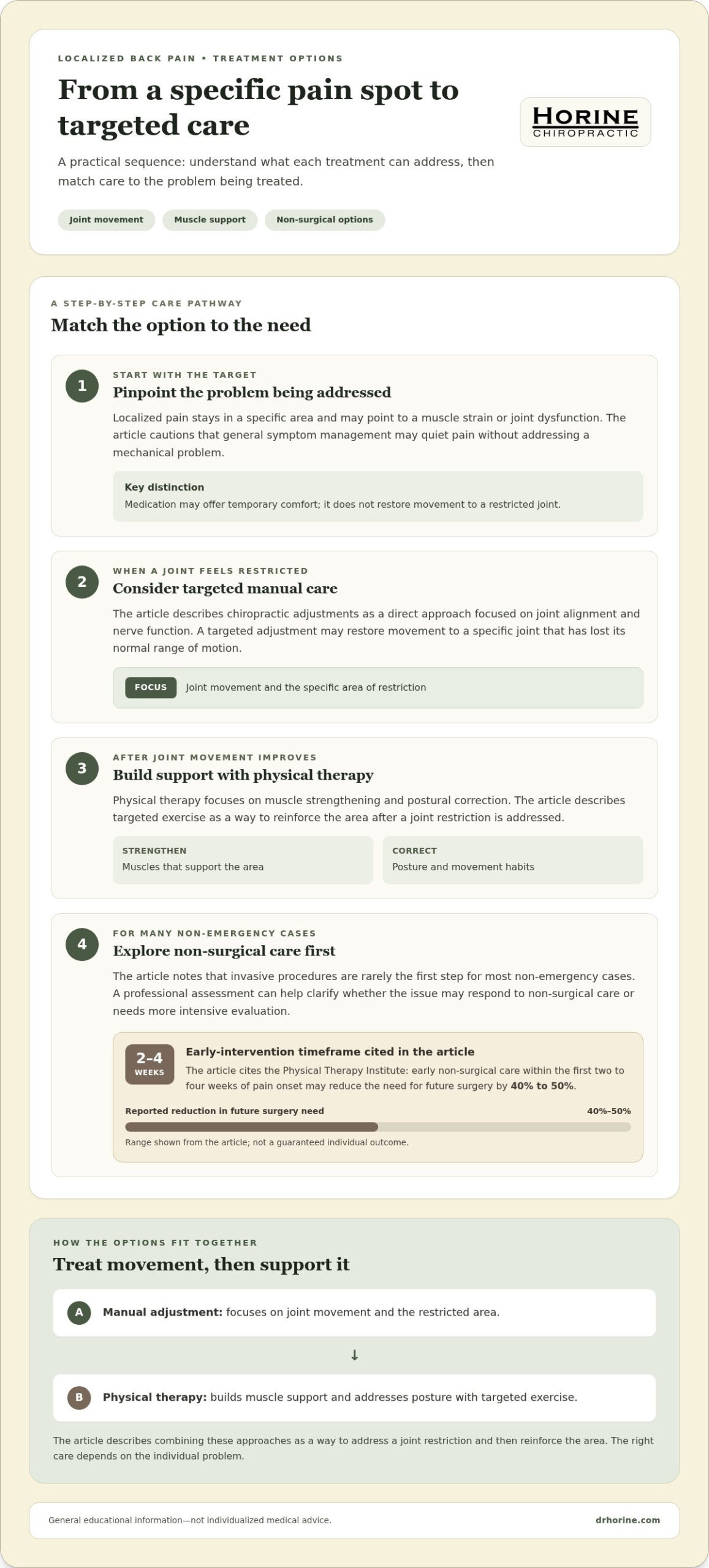
Choosing the right localized back pain treatment depends on understanding how different options interact with your physical structure. Medications are generally a passive recovery tool; they work by chemically blocking pain signals or reducing systemic inflammation. While this offers temporary comfort, it doesn’t address the physical “fixation” of a joint. Manual spinal adjustments, however, are a direct, active approach. They target the specific vertebrae that have lost their normal range of motion, restoring alignment and relieving pressure on the surrounding nerves. If a joint is physically stuck, a pill cannot move it, but a targeted adjustment can.
Chiropractic Care vs. Physical Therapy
Patients often wonder whether they should see a chiropractor or a physical therapist for a specific “spot” of pain. The answer usually lies in what your body needs at that exact moment. Chiropractic care focuses heavily on joint alignment and nerve function. When a specific area in your back feels locked or pinched, an adjustment can provide immediate localized relief by restoring movement to that joint; those interested in gentle, transformative wellness can check out Livelovelife Chiropractic as an example of this approach. Physical therapy excels at muscle strengthening and postural correction. Once the joint is moving correctly, PT helps build the internal support system needed to keep it that way. In many cases, the gold standard for recovery is a combination of both: clearing the joint restriction first, then reinforcing the area with targeted exercise.
Non-Surgical vs. Invasive Procedures
It’s natural to worry that localized pain indicates a serious structural issue requiring surgery, but for most non-emergency cases, invasive procedures are rarely the first step. Research from the Physical Therapy Institute indicates that early intervention with non-surgical care, often within the first two to four weeks of pain onset, can reduce the need for future surgery by 40% to 50%. Exploring a Non-Surgical Back Pain Treatment path is often the most effective way to find lasting relief without the risks of the operating room.
Targeted manual therapy and diagnostic exams can resolve many issues that feel “structural” but are actually functional. If your pain is interfering with your daily life, a professional consultation can help you determine if your issue is a simple mechanical fix or something requiring more intensive care. We focus on finding the least invasive path to getting you back to your normal activities as quickly as possible.
Diagnostic Precision: Finding the Root of Localized Pain
Effective localized back pain treatment doesn’t begin with a table or a tool; it starts with a thorough investigation. Think of your first visit as a diagnostic “hunt” where we look past the surface ache to find the specific mechanical failure. We begin by analyzing your posture and range of motion to see how your body compensates for the pain. By observing how you move, we can often see which muscles are overworking and which joints have stopped doing their share. This investigative process is vital because treating the “where” without understanding the “why” only leads to temporary relief that fades by the time you reach your car.
Your personal history plays a massive role in this discovery phase. A specific lifting incident, a recent change in your desk setup, or even an old sports injury can provide the context we need to identify your triggers. We take the time to listen to your story because your daily habits often hold the key to your recovery. This deep dive ensures that your care plan isn’t a generic template, but a personalized roadmap designed for your specific physical needs. Without this level of diagnostic precision, finding a permanent solution is mostly a matter of luck.
The Role of the Physical Examination
During the exam, we use palpation to check for inflammation or misalignment in the exact spot you’ve identified. When a practitioner presses on the “thumb-print” area of pain, they’re feeling for joint fixations or muscle guarding that might not show up on a standard scan. We also test your leg strength and reflexes to ensure that the localized issue hasn’t begun to impact your nervous system. A diagnostic assessment is the essential bridge between the frustration of daily pain and a permanent, structured solution. This physical check allows us to confirm what your body is telling us through its movements.
This approach to physical assessment is a hallmark of quality care; for instance, Boundless Full Body Chiropractic & Rehab is a chiropractor Bottineau ND that utilizes these thorough diagnostic methods to create effective, localized treatment plans for patients in the North Dakota area.
Identifying Disc vs. Joint Issues
It’s common to fear that any sharp pain in the back is a disc herniation, but localized pain often signals a bulging disc long before it becomes full-blown sciatica. There are subtle differences in how these issues feel. Joint “stuckness” usually presents as a sharp, mechanical catch during specific movements. Disc-related localized pressure often feels like a deep, persistent ache that might intensify when you cough or sit for long periods. Modern clinical guidelines from 2026, such as those published in The Lancet Rheumatology, emphasize these functional assessments to avoid unnecessary imaging. By identifying whether the structure involved is a joint or a disc, we can tailor your localized back pain treatment to provide the most direct relief possible. If disc involvement is suspected, understanding your options for relief from herniated disc pain through non-surgical methods can be an important next step in your recovery.
A Step-by-Step Recovery Path for Localized Back Issues
Recovery is a methodical process. By moving through these stages carefully, you ensure that the specific spot causing your distress is actually healing rather than just being temporarily numbed. A successful localized back pain treatment plan follows a predictable sequence that moves from crisis management to long-term strength. This structured approach eliminates the fear of the unknown and provides a clear map for your return to health.
- Step 1: Immediate Inflammation Control. This involves using ice, resting the area, and strictly avoiding the specific activity that caused the flare-up.
- Step 2: Professional Diagnostic Consultation. We move beyond home care to identify the exact joint or muscle group responsible for the pain.
- Step 3: Corrective Phase. We use targeted adjustments or manual therapies to restore mobility to the restricted segment.
- Step 4: Stabilization. Once the joint is moving, we focus on strengthening the surrounding muscles to keep that alignment in place.
- Step 5: Long-Term Wellness. This final stage involves posture maintenance and periodic check-ins to prevent the issue from returning.
Home Care Strategies for Localized Relief
When a localized “hot spot” first flares up, your primary goal is to calm the nervous system. We recommend the “Rule of 20” for icing: apply a cold pack for 20 minutes, then remove it for 20 minutes. This helps soothe inflammation without irritating the skin or causing the muscles to seize up from the cold. During this time, perform only very gentle mobility exercises that do not put direct pressure on the painful spot. If the pain doesn’t show signs of improvement within 48 hours, or if it begins to feel sharper, it’s time to seek professional Lower Back Pain Relief in Visalia. Waiting too long can allow the body to create compensations that make the eventual recovery longer.
Professional Intervention: The Manual Adjustment
Modern manual adjustments are gentle and highly specific. When a joint is “locked” or fixated, it creates a localized pocket of inflammation and restricted movement. A targeted adjustment acts as a key that “unlocks” that specific joint, allowing the surrounding tissues to relax and natural healing to begin. You might feel a sense of immediate lightness or improved range of motion right after the session. During the first 24 hours after a localized back pain treatment, it’s normal to feel some mild soreness, similar to the feeling after a good workout, as your muscles adjust to their new, correct positions. If you are ready to stop managing symptoms and start fixing the cause, you can schedule a diagnostic exam to find your specific path forward.
The Dr. Horine Approach to Localized Pain in Visalia
Dr. Horine Chiropractic has served the Visalia community since 1987, building a practice rooted in honesty and results. When you’re dealing with a specific spot of pain that won’t go away, you need more than a generic adjustment. You need a localized back pain treatment that respects your time and your health goals. Our “Honest Care” philosophy means we skip the high-pressure sales tactics and focus entirely on what works for your body. We believe that a healthcare provider should be a partner, not a salesperson.
This patient-centered approach ensures that we prioritize your unique needs. Whether you want to get back to gardening, improve your golf swing, or simply sit through a workday without a sharp catch in your spine, we listen to your story first. We understand that localized pain is often a signal of a deeper mechanical issue, and our goal is to provide the clarity you’ve been missing. Experience a thorough diagnostic exam that doesn’t just look at your back, but truly hears your concerns.
Serving the Visalia Community with Integrity
Being a part of the Visalia community for over three decades has allowed Dr. Horine Chiropractic to treat generations of neighbors. We aren’t a corporate clinic with rotating staff; we’re a local practice that values integrity and long-term relationships. Dr. Horine’s deep roots in the area mean he understands the lifestyle of his patients, from the physical demands of local industries to the recreational activities that keep our residents active. Having a trusted chiropractor who knows your history and your community makes a significant difference in the quality of your care. We’re here to help you return to your daily Visalia lifestyle with confidence and comfort.
Your Path to Relief Starts with an Exam
The journey toward recovery shouldn’t be filled with guesswork. Your first visit is designed to remove uncertainty by providing a thorough diagnostic assessment. We take the time to investigate the “why” behind your pain, ensuring that every adjustment is purposeful and effective. You don’t have to keep “living with it” or hoping that a general stretch will eventually fix a localized mechanical problem. By starting a targeted recovery plan, you can stop managing symptoms and start achieving real physical improvement. If you’re ready for a localized back pain treatment that puts your needs first, schedule your localized pain assessment with Dr. Horine Chiropractic today.
Reclaiming Your Quality of Life
Finding relief for a specific spot of pain shouldn’t be a guessing game. You’ve learned that effective localized back pain treatment relies on a precise diagnostic hunt rather than a broad approach to symptoms. By identifying whether your issue stems from a joint fixation or disc-related pressure, you can move toward a non-surgical path that addresses the root cause. This clarity is the essential first step toward breaking the cycle of recurring injury and returning to the activities you love.
Dr. Horine has been serving the Visalia community since 1987, bringing over 35 years of clinical experience to every patient interaction. We focus on personalized, non-surgical treatment plans that prioritize your long-term wellness without any high-pressure tactics. You deserve a healthcare partner who listens to your story and provides a clear, structured path to recovery. It’s time to stop living with the uncertainty of “that one spot” and start your journey toward lasting comfort. Schedule Your Targeted Back Pain Exam in Visalia today and experience the difference that patient-centered care makes.
Frequently Asked Questions
Is localized back pain more serious than general back pain?
Localized pain isn’t automatically more dangerous, but it is more specific. While general back pain might feel like a broad, dull ache from poor posture, localized pain acts as a precision signal from a specific joint or disc. It tells us exactly where the mechanical failure is happening. Treating this requires a focused localized back pain treatment approach to ensure the correct structure is addressed before the issue leads to compensatory pain in other areas.
Can a chiropractor help with pain that is only in one specific spot?
Yes, this is exactly where chiropractic care excels. When a joint becomes “stuck” or fixated, it creates a localized pocket of inflammation and discomfort that general stretches can’t reach. A targeted manual adjustment helps restore motion to that specific vertebrae, which relieves pressure on the surrounding nerves. This focused care is often more effective for “thumb-print” pain than broad solutions because it addresses the specific joint that is locked.
For readers seeking this type of focused care, you can discover Vitalité Chiropractic and their approach to providing same-day relief and wellness.
How many treatments will I need for localized back relief?
Every patient’s recovery timeline is unique, but most plans follow a predictable path from immediate relief to long-term stability. Your initial phase focuses on controlling inflammation and restoring joint mobility. Once the acute pain subsides, we move into a stabilization phase to strengthen the surrounding muscles. We’ll outline a clear, structured plan during your diagnostic exam so you know exactly what to expect at every stage of your recovery journey without any guesswork.
What happens if I ignore localized back pain for too long?
Ignoring localized pain often leads to a recurring cycle of injury and compensatory movement patterns. When one joint isn’t moving correctly, your body forces other joints and muscles to work harder to pick up the slack. Over time, this can turn a simple mechanical fix into a more complex issue involving multiple areas of the spine. Early intervention is the most effective way to prevent a localized flare-up from becoming a chronic, long-term problem.
Is it better to use heat or ice for a localized back injury?
Ice is generally the best choice for a new, localized injury where inflammation is present. We suggest the “Rule of 20,” which is applying ice for 20 minutes to soothe the area without irritating your skin. Heat is better suited for chronic muscle stiffness or long-standing aches, as it increases blood flow to the tissues. If you’re unsure which to use, it’s safest to start with ice to keep the localized swelling under control during the first 48 hours.
Will my insurance cover localized back pain treatment in Visalia?
Many insurance plans provide coverage for chiropractic services, but the specific details depend on your individual policy. Most major providers recognize the value of non-surgical care for spinal issues. Since every plan has different deductibles and copays, it’s a good idea to have your coverage verified before starting a localized back pain treatment plan. Our team can help you understand your benefits so you can focus on your recovery instead of worrying about the details.
Can localized back pain be a sign of a herniated disc?
Yes, a sharp or deep ache in one specific spot can be an early warning sign of a disc issue. While many people associate herniated discs with shooting leg pain, the problem often starts as localized pressure in the lower back. A thorough physical exam helps us differentiate between a simple joint fixation and a disc that is beginning to bulge. Catching these issues early allows for more conservative, non-surgical treatment options that prioritize your long-term health. For those concerned about disc involvement, exploring your options for relief for herniated disc pain through non-surgical approaches can help you understand the full range of care available.
What is the difference between a general adjustment and a localized one?
A general adjustment focuses on overall spinal health, while a localized adjustment is a precision strike on a specific mechanical problem. During a localized session, we “hunt” for the exact vertebrae or muscle group that is causing your flare-up. This targeted approach ensures that we aren’t just moving bones, but specifically unlocking the restricted segment that is triggering your pain. It’s the difference between a broad tune-up and fixing a specific part that has stopped moving correctly.
Article by
Dr. Russell Horine, DC Chiropractor
Horine Chiropractic has established a strong reputation for delivering exceptional results in treating complex back and neck pain cases. Their primary objective is to serve patients efficiently and compassionately, aiding them in their journey to wellness. Horine Chiropractic uses a comprehensive, groundbreaking approach to treating stubborn back and neck pain. They have been helping Visalia’s backs, necks, and everything in between for a combined 45 years. They create a comprehensive approach to help their patients meet their health needs. Horine Chiropractic customizes treatment plans to meet each patient's unique health needs. The clinic is accepting new patients and providing compassionate care to those in need.
Medical Disclaimer
This content is provided for general educational and informational purposes only and is not intended as medical advice, diagnosis, or treatment. Individual conditions and treatment needs vary. Please consult a qualified healthcare professional regarding your specific symptoms and treatment options.