
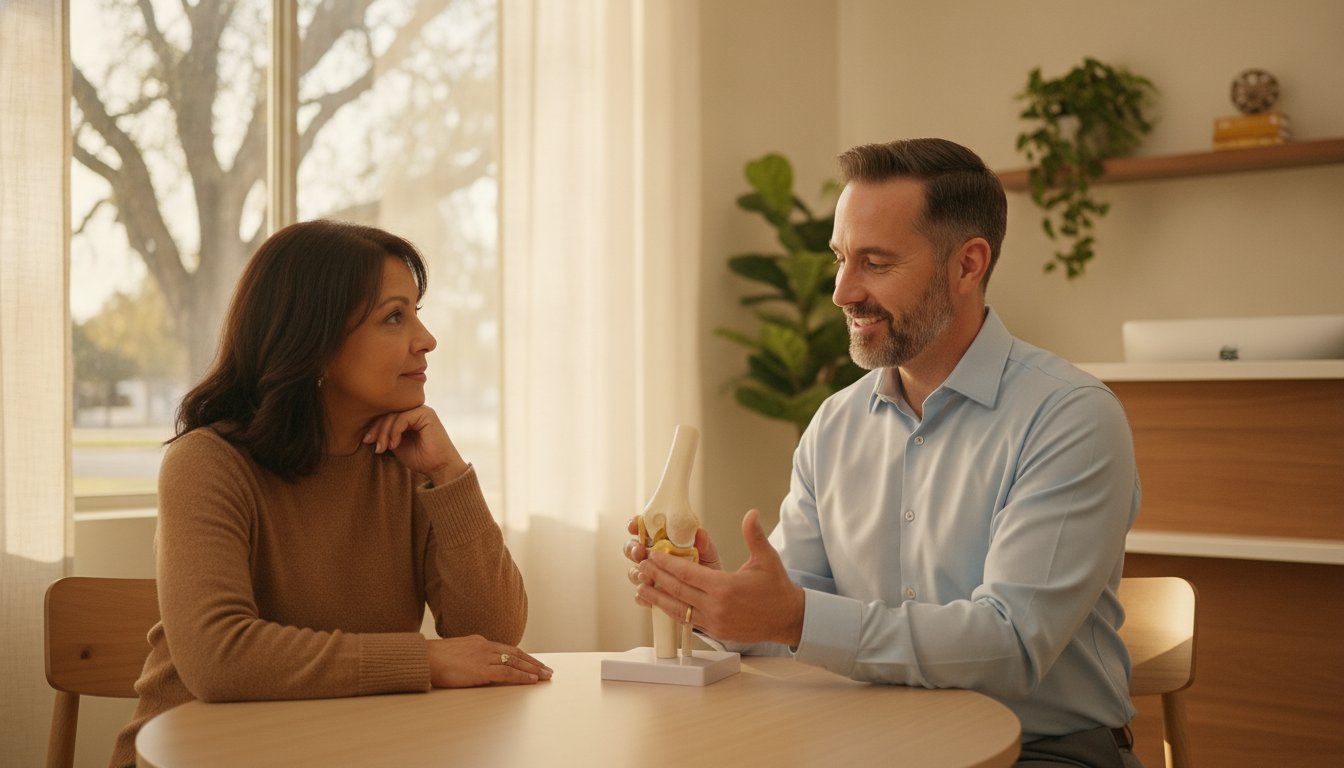
Imagine you’re finally heading out for a stroll through Mooney Grove Park, but that first step off the curb sends a sharp, stabbing sensation through your leg. Or perhaps you’ve spent the afternoon at your desk, only to find your joints feel like rusted hinges when you finally try to stand up. Understanding what causes sore knee issues is often the first step toward getting back to the life you love here in Visalia. You’ve likely felt the frustration of pain that comes and goes without warning, making you hesitate before every flight of stairs or walk to the mailbox. It’s exhausting to deal with stiffness that lingers long after you’ve finished your morning coffee.
We understand how these physical limitations weigh on you, and we’re here to help you find the clarity you deserve. This guide explores the common and hidden triggers of your discomfort, showing you how a biomechanical approach can reduce pain without the need for invasive procedures. You’ll learn why your knee might actually be acting as a silent alarm for imbalances in your hips or spine. We will walk through the investigative process together, providing a clear, structured path to help you return to your favorite local activities and daily routines with total confidence.
Key Takeaways
- Knee soreness is often a warning signal that mechanical stress is exceeding your joint’s capacity, affecting everything from your cartilage to your tendons.
- To truly understand what causes sore knee issues, you must identify whether the source is a sudden injury or the “slow fade” of chronic wear and tear.
- Your knee health is deeply connected to your hips and spine; often, the knee is simply the “victim” of imbalances elsewhere in your body’s kinetic chain.
- Moving beyond temporary home care requires a thorough diagnostic exam to uncover the root cause of your specific stiffness or stabbing pain.
- A personalized, non-invasive approach can help you regain mobility and return to daily activities like climbing stairs or walking in local parks.
Common Culprits: What is Causing Your Sore Knee?
Your body is remarkably good at communicating when something isn’t right. Think of knee soreness as a built-in alarm system. It’s a clear signal that the mechanical stress you’re placing on the joint has finally exceeded its capacity to recover. Knee pain is a multifaceted symptom resulting from either a single event of acute trauma or the slow buildup of cumulative mechanical stress over time. Inside the joint, several key players work together to keep you moving: bones provide the framework; cartilage acts as a shock absorber; ligaments hold everything together; and tendons connect your muscles to the bone. When you try to “power through” the discomfort, your body often compensates by shifting your weight. This usually leads to a new set of problems, including compensatory injuries in your opposite leg, as it takes on a burden it wasn’t meant to carry.
Understanding the Location of Your Pain
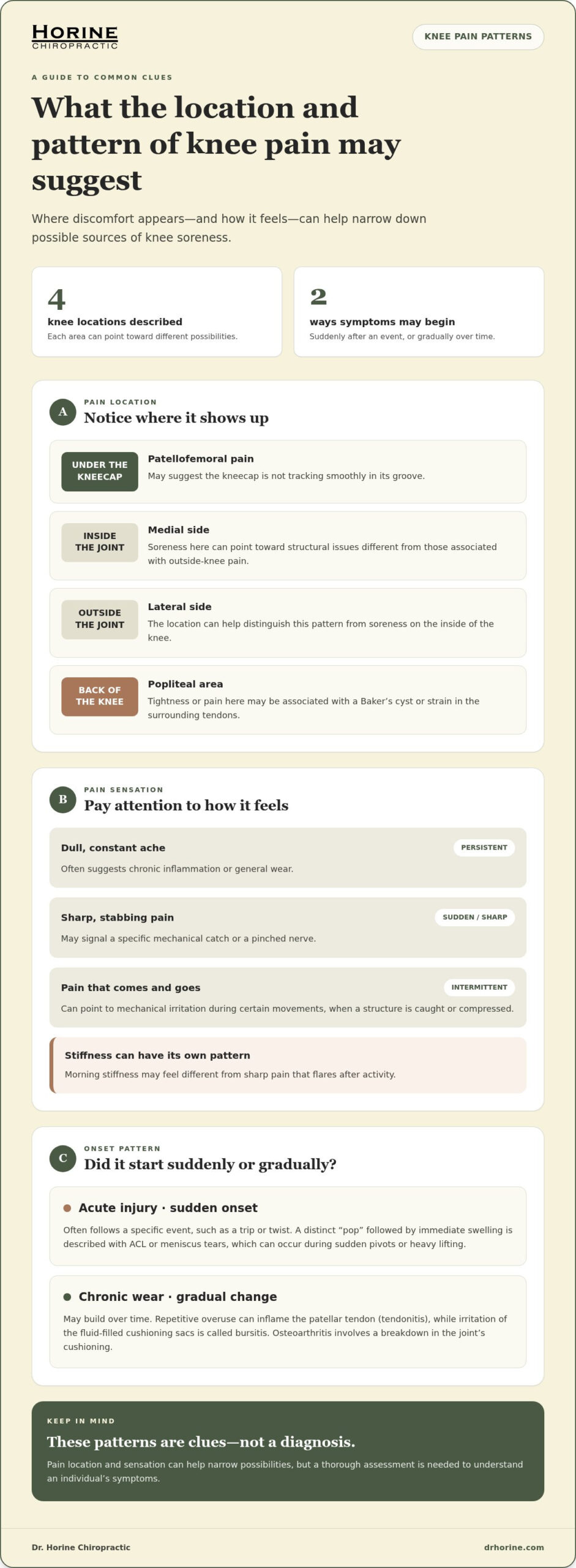
Where you feel the discomfort often tells a story about what causes sore knee issues in your specific case. If you feel pain directly under the kneecap, it’s often patellofemoral pain, which suggests your kneecap isn’t tracking smoothly in its groove. Soreness on the inside of the joint, known as the medial side, often points toward different structural issues than pain on the outside, or lateral side. Meanwhile, a tight or painful sensation in the back of the knee, called the popliteal area, typically indicates issues like a Baker’s cyst or strain in the surrounding tendons that support your leg’s stability.
Soreness vs. Sharp Stabbing Pain
The type of sensation you feel is just as important as where you feel it. A dull, constant ache often suggests chronic inflammation or general wear, while a sharp, stabbing pain usually signals a specific mechanical catch or a pinched nerve. If your pain “comes and goes” without a clear reason, it often points to intermittent mechanical irritation, where a structure is getting caught or compressed during certain movements. You might notice that morning stiffness feels like your joint is stuck in glue, which is quite different from the sharp pain that flares up only after you’ve been active for an hour. Recognizing these differences helps us narrow down the root of the problem rather than just masking the symptoms.
Acute Injuries vs. Chronic Wear: Identifying the Source
Pinpointing what causes sore knee symptoms starts with a simple question: did it happen all at once, or has it been a slow fade? Acute injuries are like a sudden storm; they’re loud, immediate, and usually tied to a specific trip or twist. Chronic wear, on the other hand, is more like a slow leak that gradually erodes your comfort. In both cases, inflammation plays a starring role. While it’s meant to be a temporary healing response, it often goes into overtime, leading to persistent swelling and stiffness. This is a common hurdle for our neighbors here in Visalia who enjoy active lives, whether they’re tending to a large garden or walking the trails at Mooney Grove Park. These issues fall under the broader umbrella of musculoskeletal health, where the goal is to restore balance before the wear becomes permanent. By addressing the root cause, we can often stop the cycle of inflammation before it leads to more serious degeneration.
Common Structural Injuries
If you felt a distinct “pop” followed by immediate swelling, you likely experienced a structural injury. This sensation is a hallmark of ACL or meniscus tears, which often occur during sudden pivots or heavy lifting. There are many Common causes of knee pain that fall into this category. For others, the pain is more gradual. Tendonitis occurs when the patellar tendon becomes inflamed from repetitive overuse, while bursitis involves the irritation of the small, fluid-filled sacs that cushion your joint. These structural issues can make simple tasks like standing up from a chair or climbing stairs feel like a monumental effort. Each of these injuries requires a specific approach to ensure the joint heals without creating long-term instability.
Degenerative Changes and Arthritis
Osteoarthritis is often described as “wear and tear” on the cartilage, but it’s more accurate to think of it as a breakdown in the joint’s cushioning. It’s a common misconception that an arthritis diagnosis means you must stop moving. In fact, gentle, guided movement is often exactly what the joint needs to stay lubricated. Movement is still key. Sometimes, a “new” soreness is actually an old injury from years ago finally making its presence known. Understanding what causes sore knee flare-ups in these cases is the first step toward regaining your quality of life. If you’re tired of guessing why your mobility has changed, a thorough musculoskeletal assessment can help you find the answers you need. We focus on how your body moves as a whole, ensuring that your path to relief is as unique as your history.
The Biomechanical Connection: How Your Hips and Spine Affect Knee Health
Many people focus only on the joint itself when wondering what causes sore knee discomfort, but your body doesn’t work in isolated parts. It operates as a kinetic chain. This is a continuous link of joints and muscles starting from your feet and moving up through your knees, hips, and spine. When one part of this chain stops moving correctly, the stress has to go somewhere else. Often, the knee becomes the “victim” of mechanical issues occurring above or below it. For example, a tilted pelvis can force your knee to rotate unnaturally with every step you take, leading to friction and pain that ice alone won’t fix. Dr. Horine’s experience as a chiropractor for joint pain focuses on restoring this entire chain to its natural balance. This holistic view is exactly why a localized approach often fails to provide lasting results.
The Pelvis and Hip Link
Your hips act as the steering wheel for your legs. If your hip muscles are weak or your pelvis is misaligned, it often leads to a condition called “knee valgus,” where the knees cave inward during movement. This misalignment can also create a functional difference in your leg length, causing you to distribute your weight unevenly. When we look at what causes sore knee issues, we often find that adjusting the hips provides much faster and more sustainable relief than treating the knee in a vacuum. If you also experience tightness or a locking sensation in your hip joint itself, exploring chiropractic for hip stiffness can be an essential part of resolving the full kinetic chain imbalance. By leveling the pelvis, we remove the torque that’s been pulling your knee out of its proper track. This unhurried, investigative approach ensures we aren’t just chasing the symptom, but actually correcting the underlying mechanical flaw.
Foot Mechanics and Your Knees
Your feet are the foundation for every step you take in our beautiful Visalia parks. If your feet overpronate, or “flat foot,” it forces your lower leg to rotate inward, which puts immense strain on the knee joint. Even a common issue like plantar fasciitis can change the way you walk as you subconsciously try to avoid heel pain. This altered gait sends ripples of stress up the leg, eventually causing soreness in the knee. For our active local community, wearing proper footwear and ensuring your foot mechanics are sound is essential to preventing long-term joint wear. We take the time to analyze your gait, looking for these subtle foundation issues that might be sabotaging your mobility.
Recognizing the Signs: When to See a Specialist in Visalia
Most of us try to be our own doctor first. You might reach for an ice pack or a compression sleeve after a long day of yard work, hoping the soreness will just vanish by morning. While basic home care is a great starting point, there comes a time when simply resting isn’t enough to address what causes sore knee issues at their root. Waiting too long often forces your body to develop “compensatory movements.” This means you start walking differently to avoid the pain, which eventually leads to new problems in your back or hips. Early intervention is the best way to stop this cycle before it changes how you move permanently.
The “Red Flag” Symptoms
Some signs require immediate attention to prevent permanent damage. If your knee feels like it’s “giving out” when you try to stand, or if you can’t bear any weight on the leg at all, your joint’s stability has been compromised. You should also look for visible deformities or significant swelling that doesn’t improve after 48 hours of rest. Another serious sign is numbness or a “pins and needles” sensation that radiates from your lower back or travels down toward your foot. These neurological symptoms suggest that a nerve might be involved in your discomfort, requiring a more specialized look at your spinal alignment. While seeking local care is vital, you can also discover The Orthopaedic & Sports Medicine Institute to see how specialized centers elsewhere approach the diagnosis and treatment of complex structural issues.
Not every problem is an emergency, but that doesn’t mean you should ignore it. You might notice that your pain returns every single time you try to increase your activity level, like going for a longer walk or returning to the gym. Morning stiffness that lasts for more than 30 minutes after you wake up is another common sign that the joint needs professional help. If you find you can no longer fully straighten your leg or squat down as easily as you once could, your range of motion is decreasing. These “nagging” issues are often the body’s way of asking for a mechanical tune-up.
Finding the answer starts with a thorough investigation. A professional diagnostic chiropractic assessment looks at your body as a whole, ensuring we don’t miss the subtle imbalances that lead to chronic pain. We’ve helped Visalia residents find these answers since 1987, focusing on non-invasive ways to get you back on your feet. If you’re ready to stop guessing and start healing, we invite you to schedule a personalized consultation to see how we can help you regain your mobility.
A Personalized Path to Relief at Dr. Horine Chiropractic
Step into our office and you’ll immediately feel the difference from a standard, cold clinical environment. We’ve focused on providing honest, patient-centered care to the Visalia community since 1987. We believe the best results come from a partnership between the practitioner and the patient. This starts with a warm, unhurried atmosphere where you’re heard, not just processed. When we investigate what causes sore knee discomfort, we don’t just look at the joint itself. We look at the person attached to it. Our first-visit process is designed to remove the fear of the unknown by walking you through a thorough history and physical exam before any treatment begins.
During your initial visit, we take the time to listen to your story. You’ve likely dealt with the frustration of being told your pain is just a natural part of aging, but we know there’s usually a specific mechanical reason for your stiffness. We use gentle, manual adjustments to restore proper joint tracking and alignment. This non-invasive approach helps your body return to its natural state of comfort without the need for high-pressure tactics. Our goal is to provide you with the clarity and relief you need to get back to your daily life, whether that’s working in your garden or walking the local trails.
What to Expect During Your Knee Assessment
We begin with a detailed look at your posture and gait, observing how you walk and move in real-time. This allows us to see exactly where your kinetic chain is breaking down. We’ll check the alignment of your spine and hips alongside your knee, ensuring we’re addressing the root cause rather than just chasing a symptom. From there, we create a personalized plan designed for quick relief and lasting mobility. It’s a structured path that shows you exactly what to expect at every stage of your recovery, eliminating guesswork and building confidence in your body’s ability to heal.
Moving Beyond the Knee: Holistic Care in Visalia
Our practice is rooted in the belief that treating the whole person is the only way to achieve true wellness. This holistic perspective is why we often find connections between different areas of discomfort. For instance, we provide comprehensive shoulder pain treatment alongside our knee and spinal care. We’re here to be your partner in health, providing a friendly and professional environment where you can find the answers you’ve been looking for. If you’re ready to remove the uncertainty of knee pain, we invite you to schedule a consultation and take the first step toward a more comfortable, active life.
Reclaiming Your Mobility in Visalia
You don’t have to spend another day wondering exactly what causes sore knee discomfort or why your favorite walks have become a chore. We’ve explored how your knee is often the “victim” of mechanical imbalances in your hips, feet, or spine. By looking at your body as a connected system, we can move past temporary fixes and address the root causes of your pain. It’s about more than just reducing soreness; it’s about restoring the natural alignment that allows you to move with confidence again.
Since 1987, our practice has served the Visalia community with honest, patient-centered care. With over 35 years of musculoskeletal expertise, we focus on non-invasive manual adjustments designed to provide quick relief and long-term wellness. We invite you to Schedule your personalized knee assessment with Dr. Horine today. Taking this first step removes the uncertainty and puts you back on the path to the active life you deserve. We’re here to listen, understand your history, and help you get back to enjoying everything our local parks and community have to offer.
Frequently Asked Questions
Can a chiropractor actually help with knee pain?
Yes, a chiropractor can help by identifying and correcting mechanical imbalances that lead to joint stress. We look at how your knee tracks during movement and whether your hips or feet are contributing to the load. Since 1987, we’ve used manual adjustments to restore proper function. This approach focuses on the joint’s alignment rather than just masking the discomfort with medication. It’s about helping the whole body move better through personalized, non-invasive care.
Why does my knee hurt when there was no injury?
When there is no clear accident, the pain is often caused by cumulative mechanical stress. This happens when your body compensates for issues in your kinetic chain, such as a tilted pelvis or flat feet. Understanding what causes sore knee symptoms without a specific injury requires looking at your daily habits and posture. Over time, these small imbalances add up, eventually exceeding your joint’s ability to recover and causing noticeable stiffness or persistent aching sensations.
Is it okay to walk with a sore knee?
Walking is generally beneficial because it keeps the joint lubricated, but you must listen to your body’s signals. If the soreness is a dull ache that improves with movement, gentle walking is encouraged. However, if you experience sharp, stabbing pain or if the knee feels unstable, you should stop and seek a professional assessment. Avoiding activity entirely can often lead to more stiffness and a much slower recovery process for the joint tissues over time.
What is the fastest way to relieve knee soreness at home?
The RICE method remains the standard for quick, temporary relief at home. Applying ice for 15 minutes can help reduce inflammation, while elevation helps manage swelling. You might also try very gentle range-of-motion exercises to prevent the joint from locking up. While these steps provide comfort, they don’t address the underlying mechanical issue. If the soreness returns after you resume activity, it’s time to investigate the root cause with a professional diagnostic exam at our office.
Does a misaligned spine cause knee problems?
A misaligned spine can impact your knees by changing your center of gravity. When your spine or pelvis is out of alignment, your body shifts its weight unevenly to stay upright. This puts excessive pressure on one knee over the other, leading to premature wear. Correcting spinal alignment helps redistribute your weight properly, which is a key part of understanding what causes sore knee flare-ups in chronic cases. It ensures your foundation is stable and your gait is balanced.
What does a sharp stabbing pain in the knee mean when it comes and goes?
This type of pain often indicates a mechanical “catch” within the joint or intermittent nerve irritation. It might be a small piece of cartilage or a meniscus tear that only causes pain when the joint is in a specific position. Because the sensation isn’t constant, it’s easy to ignore, but it usually signals that a structural component is being pinched. A thorough physical exam can pinpoint exactly what is getting caught during your daily movements or activities.
How many chiropractic visits are usually needed for knee relief?
Every person’s path to relief is different, but many patients notice a difference within the first few visits. Our goal is to provide quick relief while working toward a long-term solution for your mobility. During your first visit, we’ll outline a clear, structured plan so you know exactly what to expect. We focus on practical results and unhurried care, ensuring your treatment matches the severity and history of your specific condition and your personal lifestyle goals.
When should I worry about a popping sound in my knee?
A popping sound, or crepitus, is often harmless if it isn’t accompanied by pain or swelling. It’s often just gas bubbles moving in the joint fluid. However, you should be concerned if the “pop” is followed by a sharp sensation, immediate swelling, or a feeling that the knee is locking in place. These signs suggest a structural issue, like a ligament or meniscus injury, that requires a professional musculoskeletal assessment to prevent any further long-term joint damage.
Article by
Dr. Russell Horine, DC Chiropractor
Horine Chiropractic has established a strong reputation for delivering exceptional results in treating complex back and neck pain cases. Their primary objective is to serve patients efficiently and compassionately, aiding them in their journey to wellness. Horine Chiropractic uses a comprehensive, groundbreaking approach to treating stubborn back and neck pain. They have been helping Visalia’s backs, necks, and everything in between for a combined 45 years. They create a comprehensive approach to help their patients meet their health needs. Horine Chiropractic customizes treatment plans to meet each patient's unique health needs. The clinic is accepting new patients and providing compassionate care to those in need.
Medical Disclaimer
This content is provided for general educational and informational purposes only and is not intended as medical advice, diagnosis, or treatment. Individual conditions and treatment needs vary. Please consult a qualified healthcare professional regarding your specific symptoms and treatment options.